

Tuesday, October 6, 2026

It’s OK To Be Ignorant About Annuities…Just Keep It To Yourself.

My LinkedIn Conversation:

I was scrolling through my LinkedIn feed and came across a conversation that one of my friends was having with a lady whose profile said she was a CFP® and also a “Fee Only Advisor.”  What were they discussing?  Annuities!  You veterans know how this conversation was going with a “fee only advisor” discussing annuities!  This conversation did not disappoint.  Below is one of the responses the fee only advisor made, literally cut and pasted:

“Most of them (annuities) never made sense to me. If a client has plenty of assets, the guaranteed lifetime income option would never be used because almost 99% of time you will have to annuitize the annuity. If a client has limited resources, very few choose to go with the guaranteed income option either because you lose the access to the lump sum, which is risky in its own way too. In rare situations, it might make sense, depending on the clients overall asset and income level. To be honest, I’ve only seen 1-2 clients in retirement really annuitize the annuity for guaranteed lifetime income. The majority of them use free withdrawals and kind of treated it as poorly performed investment account. Most of the time, annuities, especially fixed/fixed index were sold to investors who are scared of market ups and downs with very high commissions.”

The above is exactly the talking points that we have all seen from folks like her–anti annuity and usually “Fee Only” advisors.  And these talking points are misinformed.

Now, on a website (LinkedIn) where many professionals come together to learn from others, I would typically find this commentary very benign.  Afterall, none of us know everything about everything.  However, you and I deal with this crap every week coming back to us from our clients that had been communicated to them by another “advisor”!  You and I both know that this “Fee Only Advisor” communicates this misinformation with their clients every time the annuity conversation comes up.  As a result, this misinformation is perpetuated and consumers that need annuities are now convinced that annuities are bad.  So, to folks like this:  It is OK to be ignorant.  As a matter of fact I will help people like her overcome her ignorance on annuities because that is what I do.  However, communicating this same ignorance to clients is very harmful. 

Where is she wrong?  First off, most annuities that are offered to clients for guaranteed lifetime income are not offered with the intention of annuitizing the contract.  Annuitizing the contract does indeed–as she said–forfeit a good amount of control.  Furthermore, the most prominent lifetime Income annuities today have “Guaranteed Lifetime Withdrawal Benefit” riders that are merely withdrawals from the contract that are guaranteed to last forever, even after the accumulation value hits zero.  If one dies before spending down their value, the balance goes to the beneficiary.  If one wants to cash out at any time, they can.  Beware of surrender periods however.  This “Fee Only Advisor” is living 25 years in the past when GLWB riders didn’t even exist and “lifetime income” was achieved only through annuitization (GMIB riders for xample).  

I also love it that somebody who is likely charging her clients 1% to 1.5% on assets into perpetuity is citing “high commissions” on annuities.  Over a 10-, 15-, or 20-year period of time, she would have likely charged her clients multiples of what the commissions would have been on an average annuity.

Don’t Be a One Trick Pony

Lastly, I love the stock market because “over the long run” there have been very few vehicles that have created as much wealth as the US stock market. However, I also love index annuities with GLWB riders. With that, I view our obligation to our clients to not be a one trick pony. 

For instance, for a 46-your old client, many securities professionals (Note: I am an IAR myself) would say it would be completely stupid for that client to have any of their money in an annuity with a guaranteed lifetime withdrawal benefit. They would say that over the “long run” the stock market will accumulate to a value so large that the resulting income at retirement cannot be replicated by an annuity.

That thinking is actually false in a majority of the situations. This is where I would punch the data into my simulations (Monte Carlo) and illustrate what a guaranteed lifetime withdrawal benefit would provide this 46-year-old at say age 65 and compare that to even some fairly rosy stock market assumptions. Well, even while considering rosy stock market assumptions, if the annuity with a guaranteed lifetime withdrawal benefit is projected to provide more lifetime income, then why wouldn’t that 46-year-old put a chunk of their money in an annuity?  

The Fee Only Advisor would likely say that I am just trying to rip off that 46-year-old client by giving them a bad product so I can get my “big fat commission.”  Well, that Fee Only Advisor will have a tough time with that one because last year it was me that was that “46-year-old client.”  I did this analysis on myself and bought that index annuity for $200,000. Did I rip-off myself?  Nope.  In fact, that annuity will provide me and my wife with $44,000 per year income at my age 65.  Joint Income!  That is important because my wife will likely live forever.  With my genetics, on the other hand, I don’t even buy green bananas anymore. But I digress.

If I can demonstrate that the income in the annuity exceeds what a rosy market projection would do, the only objection left that I can see some “Fee Only” rep giving me is, “But with my wizardry, I can manage your money and give you an even rosier stock market scenario versus the already rosy scenarios you ran. And by the way, I am a fiduciary.”  Puke!
Ignorance is bliss, unless you are sharing your ignorance with consumers.  Then, that is not bliss, that is flat-out harmful.  If you are a “Fee Only Advisor” then don’t be closed minded and have an annuity “agent” you can refer your clients to if those clients need an annuity.  Conversely, annuities aren’t for everybody!  So, if you are “insurance only,” it may be smart to have a Registered Rep or an RIA/IAR where you can refer business to.

Why Did Mike Tyson Lose To Jake Paul?

This intentionally idiotic title has many of you saying, “Because he’s 31 years older than Jake Paul! Duh!” Of course that’s true! However, I would argue that even if Mike was still in his 20-year-old body today, that his mindset would inhibit his performance versus who he truly was 40 years ago. Allow me to explain and then draw a corollary to our business.

As I write this article I am somewhat disappointed that I wasted my Friday night watching this very boring Tyson vs. Paul boxing contest on Netflix, even aside from the technical glitches! However, the ladies fight was a great match. But I digress. I had hoped that Mike Tyson would knock out Jake Paul. I like Mike Tyson as he gets older, and he is the GOAT (greatest of all time). However, I have been a realist and understand that Mike Tyson is 58 years old, and Jake Paul (at age 27) is in the prime of his life physically. Father Time has an undefeated record. And Jake Paul is actually a great athlete not to be taken lightly! My friends thought I was crazy when I said that Jake Paul was going to win, much to my chagrin. Jake did indeed win by unanimous decision.

(Note: Many folks believed the match was “rigged.” Whether it was or not is not the point. Either way, my comments below are hard to deny.)

Me believing that Mike Tyson was not going to win had less to do with his physical abilities and more about his mindset as he has aged. Afterall, I have recently seen the training videos where he’s still destroying the heavy bags at lightning speed. Those training videos led many to say, “The old Tyson is back, and Jake Paul is in trouble!” I never bought into “Mike Tyson being back.” My lack of confidence in Tyson was not because of his aging physical abilities, but because his body language is completely different than what it used to be, which is insight into his psyche that used to drive him to knock people out. Again, what drove Tyson to kill his opponents when he was 20 years old was just as much about his psyche as it was his physical abilities, although his physical abilities were clearly superior. (I am obviously not a psychologist, but here is my view.)

In short, Mike Tyson does not have the killer instincts like he used to, even though leading up to this fight he convinced millions that “the old Mike is back.” Wrong! His body language, whether at the weigh-ins, photo sessions, on his way to the ring, or even while he is in the ring, is not as laser focused on his prey as the 20-year-old Mike was.

Thirty years ago, as he was entering the ring, or already in the ring, he only looked in one of two directions: Directly at his prey, or to the ground as he was contemplating how he was going to destroy his prey. It was internal, deep down in his gut. He wore all black, not looking around at what others were saying about him or cheering about. You knew that he was internally processing (maybe in an unhealthy way) what he was going to do to his opponent and how he was going to achieve his goal. He was hungry.

Today Mike’s body language tells me that he has lost this mindset when it comes to boxing. As far as body language, it is almost like Mike Tyson has become more concerned about other things than just achieving the “goal” of knocking somebody out. He’s looking around at his surroundings and not so much laser focused like a lion about to attack a bunny rabbit. When they ask for his commentary on what he is going to do to his opponent, he kind of shrugs his shoulders and says something fairly benign and non-convincing, almost like he doesn’t believe it himself. The 1980s and 1990s Mike Tyson made comments that you know he believed in his heart and gave some of us children nightmares. Do I dare say that today’s Mike Tyson seems self-conscious? Or certainly more “conscious” of things other than destroying his opponent.

However, why should he really want to absolutely kill somebody? Afterall, he has hit the pinnacle of the business, made millions of dollars, and has nothing to prove to anybody, certainly not to a 27-year-old kid (Jake Paul). He has become domesticated. Sometimes already hitting your “goals” will make you domesticated.

I bring all this up because once you have achieved high levels of success in our business and hit your “goal” you can become “domesticated.” Hence, the reason why we should continue to make new goals. I launched CG Financial Group, an IMO for independent agents, six years ago. As time has gone by, I hit a lot of goals that I set for my business. Every time I hit a goal, there was an inclination for me to say, “Let’s take a little break because I’ve earned it.” The fire burns out a little. This is called getting “fat and happy,”

Because I try to self-reflect a lot, I know when I am feeling “fat and happy” and therefore have made conscious efforts to quickly remedy this mindset along the way. You cannot let yourself get fat and happy, at least when it comes to doing something that you want to continue to grow. Naturally, Mike Tyson is a 58-year-old guy that no longer wants to beat people up, which makes it OK for him to be “fat and happy.” Conversely, I bet when it comes to your business and your growth aspirations, you do not want to get “fat and happy” and stagnant.

I have found that setting continuous goals and extending out the goal post is important for me in order for me to not become “domesticated.” Feeling “uncomfortable” is needed. If you continue to set goals for yourself and have a laser focus on that prey/goal, it is impossible for you to lose your edge. Again, I’m not suggesting that Tyson should be obsessed with being the world champion again, I’m just drawing the psychological corollary to why Tyson is not as “good” of a boxer as he used to be, aside from the fact that he is forty freaking years older!

When it comes to setting and hitting your goals, be that 20-year-old Tyson, don’t be self-conscious, don’t care about what those around you are saying about you, don’t get comfortable, don’t get “fat and happy,” and keep moving forward.


My Dad, The Dock Union Strike, And Keeping Up With Times

My dad died in 2006. Although my dad had many flaws, to me and my brother he walked on water. He was incredibly good to me and my brother growing up and taught us how to hunt, fish, cuss, deal with life’s ups and downs, and taught us a relentless work ethic. He owned an underground construction (water, drainage, sewer), and concrete business and was one of the toughest guys that I’ve ever known. He worked every day until he died at age 62, which was in 2006.

Anyway, if you know his blue-collar hard headed type, you know that sometimes evolving with the times can be difficult. For instance, I was telling my wife the other day that if dad was still alive during the height of the Covid pandemic where there were vaccine mandates, mask mandates, etc., that I’d be very curious how he would have fit in. You know what I’m talking about. That’s not a political statement; it’s just me saying that he probably would not have “complied” very well because he had strong and independent beliefs, but you always knew where you stood. You know the type of person I am talking about.

This type of person often gets stuck in their own ways. Again, he had his flaws as many of us do! However, as I grew older, I realized that my dad was a much smarter and a much more complex guy than what meets the eye. For instance, I was immensely proud of him when I learned that he had actually bought a laptop computer as well as a sewer pipe camera, where instead of having to dig up sewer lines to see what the issue was, he used technology! Go figure. It was actually a fairly sophisticated set-up 20 years ago, whereas today you just buy something and “Bluetooth” it to your phone. He bought a van where the TV, laptop, electrical wiring, etc. were housed. It looked like an FBI surveillance vehicle, not that I know what that looks like. As a guy who dropped out of high school to start his own business, he was now using computers and fairly sophisticated equipment! It was crazy to me that somebody as hard headed as him would get out of his comfort zone to learn modern technology when before this his giant calloused fingers had never even touched a computer keyboard. But he understood that he had to adapt with the times or be a victim of “creative destruction.”

I’m writing this article because I was reminded of this with the East Coast “Port strike” that took place in early September. It has been “sidelined” for 90 days while they negotiate. I’m not going to give my opinion on anything other than the “automation component” of the strike.

One of the items that the union is requesting is that the port employers do not automate the docking/undocking functions. Naturally, by automating this would mean that computers and machines would replace the jobs of the employees. Well, if using computers and machines is the more cost effective and efficient way to do it, then I find the demand of not automating very far-fetched. In a capitalist society, for somebody to request that employers turn a blind eye to automation—which is equivalent to attempting to halt aging—is a crazy request.

Automation is inevitable. If the employers do not automate, then there will be other similar businesses that will open up, they will automate, and because their pricing will be better (because of a more efficient business) the non-automated companies will subsequently go out of business. At that point everybody at the obsolete company loses their jobs! Again, automation is inevitable and keeping out automation is like trying to keep my head dry with my hand in a rainstorm. The rain eventually seeps through. Automation will happen and it must happen.

How does this relate to our business? It very much relates to our business. I say this lovingly, but if you are very much “hard headed”—like me and like my dad—you might find yourself sticking to what has always worked. We hear this all the time; people stick to “what they are comfortable with and familiar with.” But is the “familiar” the most efficient? I try to force myself to get out of my comfort zone every day.

Simple example, if you are an agent that still prefers paper applications, electronic applications can shave off 75 percent of the time it takes to complete the application. That’s right, instead of an hour to complete an application, maybe it’s only 15 minutes. Go through the learning pains on the front end to be efficient over the long run.

Or what about a CRM system? Do you just have your clients stored in your memory bank? Or, are you using a CRM system that not only stores their information but also alerts you when special dates arrive? That is innovation/automation.

What about new products and product lines? Are you “stuck” with old products that you are comfortable with, or do you look to what the latest and greatest is? Annuities are better than they have ever been. Linked Benefit/Hybrid LTC products are better than they have ever been. Partner with an IMO where you can continue to learn about these new developments.

Efficiency and automation can also include leveraging what other people are doing. For instance, I have 400 agents that I work with across the country. I do monthly client webinars on long-term care planning, Social Security planning, estate planning, retirement planning, etc. I invite agents to invite their clients to my webinars where the agents are almost guaranteed appointments by the end of it, because the clients connect with what I say. If I’m already doing the webinar, why would the agents not take advantage of that? That is a form of automation/efficiency.

There are many other examples in our business that I could cite where we need to get out of our “comfort zone” so we are not victims of evolution, or on the bad side of “creative destruction.”

It’s important that we run businesses as efficient as our competitors so that we are not “automated” out of existence. I myself know how hard this is, as somebody that is “old school” in many different ways. I still read the Wall Street Journal via the paper version versus the tablet/phone version. And, of course, I love my “Print Version” of Broker World!

Whole Life Flexibility And Case Design (Part 2 Of 3)

In part one of the series, and in last month’s edition, we discussed how it is perceived that whole life insurance is very rigid because the structure of the base policy “generally“ requires the premium be paid for the duration that the product was designed for. But then I countered that argument by discussing the various nonforfeiture provisions, the most popular one being “reduced paid-up insurance,” at least for the cash accumulation sales. For instance, one of my favorite products is a “Pay to age-75” product. However, I will often do a “seven pay“ design where at the end of that seventh year we do a “reduced paid up policy” where no other premium is required. You can also have dividends pay premiums if dividends are robust enough. So again, the thought that whole life requires premium to be paid is false.

In this article I would like to discuss very briefly the various dividend options and have a more in-depth conversation around the fifth dividend option, Paid Up Additions. In article three we will discuss term riders for cash accumulation sales and then bring it all to a conclusion with a case design example.

First, what is a dividend in a whole life policy?
This is cash that is returned to the policyholder of a participating whole life policy whereas the policy holder has several options on what to do with that cash. The dividends are usually paid to the policyholder on an annual basis. Dividends represent the carrier having better experience than what was priced into the guaranteed components of the product. The three areas that can “outperform” the guaranteed components in the policy that generally make up a dividend payment are as follows: 1. Investment management. 2. Expense management. 3. Mortality experience.

Dividends are generally not guaranteed and therefore can generally be found in the non-guaranteed column of the whole life illustration. As said in the previous paragraph, a whole life policy has guaranteed provisions, but can also have non-guaranteed provisions like dividend assumptions. (Note: The guaranteed provisions in whole life are usually more robust than the guarantees in IUL. Hence, one of the reasons that one may prefer whole life over IUL.)

Dividend options:

  1. Cash: This is quite simply where the insurance company sends the client the check representing the dividend payment. Dividend payments are generally tax-free as long as they have not exceeded the cost basis in the policy.
  2. Premium reductions: It is possible that your policy gets to a point to where the dividends can pay the premium going forward. That would be while utilizing this option.
  3. Accumulate at interest: This is where your dividend stays with the insurance company and accumulates at a rate that the insurance company determines.
  4. Reduce an outstanding loan: If you have a loan against the policy, you can use the dividends to pay down all or a portion of that outstanding loan.
  5. Paid up additions: The big one. This is where we will spend a good chunk of the remaining article because the paid-up additions dividend option is what I illustrate about 99 percent of the time for our agents.

Paid up additions:
Paid up additions are not just a dividend option. This is also a rider you can choose where you can add premium above and beyond the base policy. That additional premium can purchase paid up additions. Usually, this dividend option along with allocating a large chunk of one’s premium payments to the PUA rider is what is done in high cash value cases. We will discuss more about product design in the third (of three) article.

Paid up additions are additional “slivers” of paid-up whole life insurance coverage on top of what you already have with the base policy. This is why when you look at the non-guaranteed side of the whole life illustration you will see the death benefit increasing year-by-year as the dividends purchase PUAs over time. Conversely, the guaranteed death benefit column does not increase. This is because the guaranteed side of the ledger typically does not include dividend payments. Alas, dividend payments are usually not guaranteed.

Although we discussed that PUAs increase the death benefit over time (without evidence of insurability by the way), that is not the main reason people love PUAs! They love PUAs because PUAs are like miniature single premium whole life policies. What that means is, the single premium design of PUAs beef up the overall cash value in the policy! Remember from our first article, the PUA lives by the same rules as the base policy whereas the cash value has to equal the death benefit by age 121 (usually). So, common sense would tell us that if we pay just one premium (PUA), that one premium had better start out as a higher cash value number than the “Pay to age 75” base policy. Afterall, the “Pay to age 75” base policy will have multiple premiums going in over time. As a matter of fact, the cash value as a percent of premium of a PUA payment is often 95 percent or so, depending on the client. Versus the base policy, which can commonly only have 15-25 percent of cash value in that first year relative to premium.

So then, can we just buy all PUAs and have the entire policy have immediate 95 percent of premium as cash value? No!

OK then, what percentage of our premium can we put into PUAs so that we have a cash value Machine? This will be our case study for the next article.

Update: Annuities Versus The Four Percent Rule Of Thumb

The following analysis on GLWBs versus the Four Percent Rule has been updated to today’s GLWB offerings.

I recently saw somebody write about how we should not compare annuities to the four percent rule. Although I agree that there needs to be additional disclosures and education in the annuity part of the conversation, I disagree with not comparing the two.

Re-Anchor Clients in Reality, Not Fairy Dust
I believe that consumers tend to “anchor” their retirement income expectations on the wrong thing and therefore should be “re-anchored” in reality. For instance, consumers should be educated on the fact that William Bengen’s study in 1994 showed that in order to sustain a stock/bond retirement portfolio for 30+ years in retirement, the consumer should take out no more than four percent of their retirement account balance that first year in retirement, adjusted each year thereafter for inflation. Consumers should also be aware of the new updated studies that show “rules of thumb” of 2.3-2.8 percent. (Note: When using these comparisons versus annuities, it is important to discuss that annuities generally do not have “inflation adjustments” as the four percent rule incorporates. More on that in a bit.)

This “re-anchoring” is important because many consumers know that the S&P 500 has gone up double digits on average for the last century and therefore overestimate what withdrawal rate they should utilize. They have seen the glorification of the “stock and bond” markets and have likely seen the mountain charts like the Ibbotson SBBI Chart. You know what charts I am referring to; those that show that the stock market has done double digit returns forever and that their $1 invested back when Adam met Eve would be worth enough to purchase their own private island today.

Thus, if a consumer has in their brain that stocks and bonds have always performed seven percent, eight percent, 10 percent, 12 percent, then they will tend to believe that their retirement withdrawal rate is beyond the four percent that the research shows. Even if a consumer has heard of the four percent withdrawal rule, they may have not had the math laid out for them yet that is specific to their situation. It is important to explain to those that love their stocks and bonds—as I do—that even though the S&P 500 could average 10 percent over the coming years, it does not mean they will not run out of money by taking only four percent of the retirement value from their stock and bond portfolios! How is this possible? Because of the sequence of returns risk that the stock portion can subject the client to and the low interest rates (still) that the bond portion can subject the client to. And because of these two risks (sequence of returns and low rates), a client should not overestimate what their portfolios can do as far as withdrawal rates. If you would like a graphic that helps you explain “sequence of returns risk” to your clients, email me.

To demonstrate my points in the previous paragraphs, I want to cite a study by Charles Schwab. In their 2020 Modern Retirement Survey they asked 2,000 higher net worth pre-retirees and newly-retired retirees about how much money they had saved for retirement and also how much money they expected to take from their retirement portfolios. The answers from the participants were that they had $920,400 in retirement savings (on average), that they planned on spending $135,100 per year from those portfolios (on average), and that they were generally confident in those dollar amounts allowing them to live the retirements they would like.

I would argue that a 14.68 percent withdrawal rate ($135,100 divided By $920,400) defies any retirement research I have seen! Naturally, Schwab then points out that—contrary to these participants’ beliefs—a $920k portfolio will run out in only seven years (obviously not including interest/appreciation). Clearly, these consumers should have the math explained to them. Even if the consumers understand the new “rules of thumb,” they may be experiencing cognitive dissonance that should be addressed by the financial professional. By doing so, you will “re-anchor” their expectations to the new realities of 2.3 percent, 2.8 percent, or four percent withdrawal rates, which will set you up for the annuity conversation that I will discuss.

I am not suggesting an agent go into a big dissertation on these individual studies. I just believe that going over the simplified math—specific to the client’s portfolios—based on these new rules of thumb should be done in order to show the power of annuity GLWBs. Although generous, using the old four percent rule of thumb will suffice in explaining the annuity value proposition. By demonstrating this math to the clients, you will be re-anchoring their expectations to realistic numbers. And only then do I believe they will realize the true power of GLWB riders.

The GLWB Conversation
Here is what my conversation looks like (many times) that I will walk our hypothetical client through.

Let’s say our 63-year-old has $100,000 in a stock and bond portfolio. I start by discussing how this 63-year-old may have the expectation that her $100k grows by five percent or so per year between now and retirement in two years. Well, based on her $110,000 (not including compounding) value at that point, what withdrawal should she take in her first year of retirement? This is where I discuss the four percent withdrawal rule, which usually surprises them because their “anchoring” is off, as we discussed. I also discuss the reasons for the withdrawal rate being only four percent, as we also discussed earlier in this article. But then I will show her $100k growing to $110k in two years at retirement. If the client wants us to assume a 20 percent return over two years, fine! I will do that instead. The math still works.

By the end of the two years, her $100k has grown to $110 k. That is when we figure the first-year withdrawal, which comes out to $4,400. Again, that $4,400 is supposed to increase with inflation, per the four percent rule.

That $4,400 is assuming everything goes correctly. That is, that she gets 10 percent appreciation between now and age 65, and also that the four percent is indeed sustainable over her 30-year retirement.

That is when I will switch to the annuity. On one of the industry’s top annuities/GLWB riders right now, her $100,000 will “rollup” by 10 percent simple interest rate for two years, then that value of $120,000 will have a payout factor of 7.5 percent for a 65-year-old. (Note: Technically this 10 percent rollup is not limited to just two years. It depends on when she activates income, which in our example is two years.) That means that there will be a $9,000 payment starting two years from now, guaranteed for life! That payment will go on forever. This GLWB payment is 105 percent higher than what our four percent withdrawal rule will provide. And you don’t have the “hoping and praying” with the annuity. Usually at this point in the discussion, the responses are in three different areas:

  1. Seems too good to be true! How can the company do that? This is a topic for another article.
  2. What if everybody lives forever? Will the company go out of business? Again, a topic for another article.
  3. But what about inflation? The four percent rule includes inflation, and the annuity does not. Let’s discuss.

Level Annuity Payment Versus Four Percent with inflation
Although I believe we are being generous to the situation by using the four percent rule instead of the more updated and lower rules of thumb, it would be disingenuous to not explain the lack of inflation on the level payout GLWBs. (Note: There are some GLWBs that have increasing income, but let’s leave the conversation to the level income for now.)

This objection about annuities not having inflation included, versus the four percent rule is a reasonable objection, as inflation adjustments can be crucial. As a matter of fact, the “inflation rule of 72” says that a 3.5 percent inflation rate—for example—will chop the purchasing power of a dollar in half in only 20.5 years (72/3.5 = 20.5 years). Meaning that $9,000 would only have the purchasing power of $4,500 in 20.5 years assuming 3.5 percent inflation.

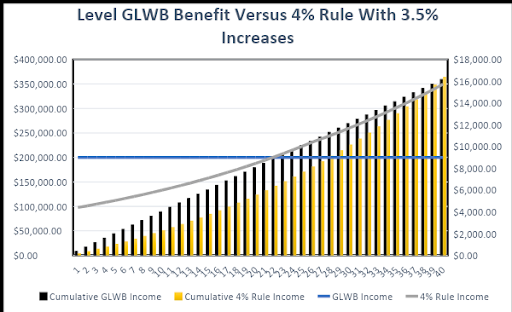
So then what provides the highest “cumulative income,” our GLWB or the four percent rule example? Included is a graph from a spreadsheet I created to show what provides more income—the $9,000 (GLWB) without inflation adjustments or the $4,400 (four percent rule) with inflation adjustments. (Note: For the inflation adjustments, I assumed 3.5 percent.)

As you can see in the chart, the inflation adjusted four percent rule annual income crosses over to where it is more than the $9,000 in the 22nd year! You can see the two lines crossing over. The dollar amounts represented by the lines are in the right axis.

Now, what is more important however is, what is the “cumulative income” from each strategy over a period of 40 years? That is represented by the bars and the left axis labels. As you can see, the Cumulative GLWB Income (Black Bar) stays higher than our cumulative four percent rule all the way through the 30-year retirement. As a matter of fact, it takes approximately 40 years for the four percent rule to catch up to our annuity income on a cumulative basis. In year-40, $364,776 is the cumulative income from the four percent rule at that point in time and $360,000 is the cumulative income from our annuity. So, in this example, only if the client lives beyond age 105 will she have garnered more income from the four percent strategy than our annuity.

Lastly, this analysis is being generous to the four percent rule because we are not incorporating the “time value of money” of the amount of excess GLWB payments we got above and beyond the four percent rule in the early years. Technically, those excess dollars reinvested would equate to even more than what our “cumulative” black bar is actually showing.

Clearly, there are other scenarios that we could run that can benefit or degrade the story on either one of the two solutions. For instance, we could run the four percent rule assuming a much higher return than 10 percent over two years, for example 20 percent. We could have taken into consideration capital gains taxes on the four percent rule of thumb versus income taxes on the annuity. But then we could also apply the “time value of money” to the excess annuity payments on the annuity. We could also use the 2.8 percent withdrawal rule. Or, one could add different inflation rates, etc.

In the end, and with all of this said, the story should be that consumers need to anchor their expectations reasonably and also that annuities have a great place in many consumers’ portfolios with or without inflation.

GLWB Now, Or Accumulate Then Choose A GLWB Or SPIA?

A question that I have from my agents occasionally is this, “Does my client do an income rider now, or do they buy an accumulation product now and then purchase an income product once they hit retirement?”

Let’s use an example to clarify this question. You have “Bill,” a 55-year-old that wants to retire in 10 years (age 65) and he has $100,000 that he is looking to tap into for retirement income at age 65. The question is, does he go with the “1-Step” strategy with just one GLWB (Guaranteed Lifetime Withdrawal Benefit) Annuity today, or does he go the “2-Step” strategy where he chooses an accumulation strategy today then in 10 years moves those funds into a GLWB Annuity or a SPIA (Single Premium Immediate Annuity)?

The Math
First off, the wonderful math that exists today around the GLWBs oftentimes make it hard to justify going with the “2-Step” strategy. Said differently, going into an accumulation product (accumulation annuity, stocks, bonds, etc.) today with the expectation that in 10 years one can accumulate enough funds to generate the same income as the GLWB product is a lofty goal.

One of my favorite GLWB annuities will pay a 10 percent simple interest “rollup rate” on the income value between now and whenever the client activates income, even if income is not activated until say age 80. So, at a 10 percent simple interest rate, it would double between now and our hypothetical client’s (Bill) age 65 (10 years). Then, this particular product has a seven percent payout factor. The end result is our $100,000 would end up with an “Income Benefit Base” of $200,000 at age 65. Then, when you multiply that $200,000 by the seven percent payout factor, that means that product would generate $14,000 per year in lifetime income that is guaranteed for life.

When you think of those guarantees on the GLWB, what is the likelihood that you could use the “2-Step” strategy to replicate that? Let’s discuss a couple ways one could look at the “2-Step” strategy and compare the $14,000 that we know is guaranteed with our “1-Step” strategy.

1) 2-Step strategy while using a four percent rule of thumb: With this strategy, Bill would accumulate funds in a good accumulation annuity or a stock/bond portfolio, then he would use the well-known four percent withdrawal strategy. Here is the quick math that I do when I assess this strategy. In 10 years, by using a four percent withdrawal rate, what would the account balance need to grow to in order to get the $14,000 in income that is guaranteed to us with the GLWB? When you divide $14,000 by .04, it comes out to $350,000. So, the question is, can Bill’s “investment advisor” reliably turn that $100,000 into $350,000 over the next 10 years in order to give him the same level of income that the GLWB is guaranteeing? The odds are up there with me winning a ballerina competition. Not likely! (Note: Technically, there is more to this conversation as the four percent rule of thumb technically includes inflation adjustments. If you would like my whitepaper on this, email me.)

2) 2-Step strategy while using an annuity in 10 years: This is the notion that we will still use an annuity, but not until it is time for income. That income can be generated from either a GLWB annuity at that time (age 65) or from a Single Premium Immediate Annuity. We will discuss both below.

GLWB at age 65: Assuming that the seven percent payout factor will still be there in 10 years on whatever value the funds have grown to, it does not take an actuary to tell us that we would need Bill’s $100,000 to grow to $200,000. Then, when he moves that $200,000 into a GLWB annuity and activates income, it would give him the same $14,000 per year. In order for $100,000 to grow to $200,000, the accumulation strategy would need to generate a 7.2 percent compounded rate of return. Can Bill’s “investment advisor” do this with 100 percent certainty? He “may” be able to double his money over 10 years, but it is definitely not a certainty. With the GLWB, that end result of $14,000 is a guarantee.

SPIA (Single Premium Immediate Annuity) at age 65: With this strategy, we use a SPIA in 10 years instead of the GLWB. Once upon a time, the gap between what SPIAs paid and what a GLWB would pay was wider. What that would mean in our example is, by using a SPIA instead of a GLWB, Bill should not need to accumulate as much in retirement savings to generate the same income as what the GLWB would, because SPIA payouts are usually larger. If our GLWB Payout Factor at age 65 is seven percent, then shouldn’t a SPIA pay out much more? Not really.

I ran a SPIA illustration from one of the top SPIA companies with the assumption that we are 10 years down the road and Bill is now age 65 and has managed to grow his $100,000 to $200,000. He now wants to move the $200,000 into the SPIA. Basically, I wanted to compare what a SPIA payout would be on $200,000 versus the $14,000 that the GLWB would guarantee us. The “Life Only” SPIA pays out $15,154 per year. (Note: If you chose a “Life and Period Certain,” as I would recommend, the payouts are even less.)

Again, $15,154 is not much higher than our $14,000 that we can guarantee today.

Using the “slightly” higher SPIA payout in our example, how much would Bill need to accumulate to get the $14,000 in guaranteed income? He would need to grow his money to around $185,000 over the next 10 years. Is it possible? Yes. Is it guaranteed? No.

Now, whether I am just generically explaining why consumers should look at GLWBs today or getting more technical and comparing the math of GLWBs today (1-Step) versus a GLWB/SPIA in the future (2-Step), there is a very important point that I always make.

These products are the best that I have seen in my 25 years in the business, which spans the entire existence of GLWBS, which started in the early 2000’s. As a matter of fact, I am sure some of you that have been around for a while are looking at my assumption in the “2-Step” strategy that these same products will exist 10 years from now with a little bit of skepticism. You would be correct. These wonderful products and the pricing around these products that exist today may not be here 10 years from now, which is actually the #1 reason I often choose the “1-Step” strategy over the “2-Step” strategy. With the “2-Step” strategy, not only is Bill hoping and praying the accumulation strategy performs well, but he is also hoping and praying that these products and pricing will still exist 10 years from now. That is a lot of hoping and praying. My commentary and experience on these products going the way of the dinosaur can be seen in this month’s issue. The title is: Annuities: My Paranoia Of Product Extinction.

The Best Candidates For ROTH IRAs And A Case Study

Some of the best candidates for Roth IRA conversions are those that have saved a lot of money (pre-tax IRAs, 401ks, etc) throughout their working years relative to their income. Those that have been a little more frugal than the average person. This oftentimes means that their retirement income can be just as much or more than their pre-retirement income. So, even if prevailing tax rates do not increase, they may still be in a higher tax bracket in retirement than they were prior to retirement. On top of that, tax rates have nowhere to go but up! No, I will not bore you with more statistics about the fiscal situation our nation may be facing.

For these folks like the above—along with many others-it might make sense to pay taxes on that “seed“ today, in order to not pay taxes on the “harvest“ later on. Especially if at harvest time your tax rates are higher. That is what a Roth IRA conversion allows people to do.

Case in point. This week we worked with a single 58-year old client who makes $93,000 per year currently, as he is still working. He is currently in the 22 percent tax bracket that goes up to $100,525 in taxable income. With his standard deduction, he is comfortably below the next bracket, 24 percent. Here is his problem: He has saved for retirement $1.5 million in pretax accounts! He has been able to amass that amount of money for a couple of reasons: 1) He has been frugal and has obsessively saved. 2) He used to make more money than what he is now with his prior job. Anyway, with that large warchest of a retirement portfolio, along with Social Security, he will be able to take retirement income that is well into the six figures and definitely higher than he is currently experiencing while in his working years. He is going to have a great retirement! However, we can help him make it even better.

For this client, the Roth IRA conversion is a perfect scenario! Also note that folks that have retired early and have a “dead period” when it comes to income are also great for Roth IRA conversions, because they are in a low tax bracket.

We are actually doing a lot of different things with his $1.5 million portfolio where we are using annuities, equities, and bonds. The part that I want to highlight for the purposes of this article is what we are doing with the $500,000 that we are putting into an annuity with a GLWB.

We are putting $500k into an annuity company that has a great GLWB benefit (obviously). This annuity will allow us to convert on a “piecemeal” basis $70k per year for the next seven years. With the mere signing of a form, a “mirror“ Roth IRA account is set up and each year we can convert a chunk ($70k) of the traditional IRA into the Roth IRA “Mirror Account.” And most importantly, the GLWB benefit base moves to that mirror account proportionately. This means that the power of the ongoing GLWB rollups will be retained by 100 percent of the client’s money, even as it moves from the Traditional IRA column over to the Roth IRA column. The taxes will be paid each year by money that will come from one of his money market accounts we have set up.

What is the end result of this? In seven years, when he retires, he will have about $60,000 per year in tax-free income that is guaranteed forever coming from this annuity! That, in addition to Social Security, will mean that he will have six-figures of retirement income that is guaranteed forever. Plus he has the other $1 million of his portfolio on top of it that we will also be partially converting as the years go by. He will do all of these conversions on a large part (not all) of his pre-tax portfolio, without ever leaving the 24 percent tax bracket, which ends at approximately $192k.

I would argue that with a six-figure income in retirement, if all of his money was otherwise “pre-tax” he would be in a higher tax bracket than 24 percent with what the future holds. We helped him significantly.

My Horrible Experience With A “Personal Banker”

A client of mine has been going crazy as she is the power of attorney for one of her family members, as well as a trustee of the revocable trust for that family member. She has been running all over the place getting affairs in order and is stressed!

This client asked for my help to go into one of the major banks (where the money is) with her to speak with a “personal banker/financial advisor” about simplifying and consolidating a bunch of the accounts, as well as making sure that everything is in the name of the trust. I volunteered to help, since estate planning is one of my specialties. Plus, I know this institution will make her life hell if I am not there to wade through the technicalities for her. I knew the odds of the personal banker understanding trust and POA issues is right up there with the odds of me being drafted to the NBA.

I figured the personal banker would not be enthused with having me there, because I am a competitor! But hey, it’s not about him, it is about my client. Plus, if everything goes smoothly, I don’t need to say a word…

The Meeting
The personal banker we met with was a young kid and, sure enough, was absolutely clueless about anything having to do with power of attorneys, springing power of attorneys, trustees on revocable trusts, successor trustees after death has happened, etc. Again, I knew this would be the case before I even walked into the bank. I’ve seen it a million times where banks hire young kids to deal with major league stuff, estate planning for example!

At first, I kept quiet. My client started out discussing details about how she needed to change the titling of the accounts to the trust as well as to make sure her POA is on file, etc. The banker then stated that this client I was with was merely the successor trustee and currently had no power to do anything—at least until death of the grantor—with any of the accounts at the bank. So, I had to educate him by pulling up the trust on my phone and telling him the successor trustee thing was for after the death of the grantor when the revocable trust becomes irrevocable. However, this person is currently one of three trustees of the revocable trust and can act independent of the other two trustees, per the first few lines of the trust documents. Eventually, I had to educate him that the trustee does indeed have the authority. (Note: That is how revocable trusts work. They become irrevocable upon death! He did not know this.)

He also initially stated that he needed the notarized signature of the grantor, who is currently in the nursing home. I said, “That’s not correct, do we drag her out of the nursing home to go to a bank to get a notary?” He said, “They probably have a notary in the nursing home.” I was trying to not internally combust. At this point, he still does not know what I do for a living because I did not pull the “do you know what I do?” card… Yet…

He even questioned the power of attorney, asking if the person/principal was incapacitated yet. I had to tell him that it didn’t matter because this was not a “springing power of attorney“ and was actually effective right now. He wasn’t going to allow her to act as POA for that individual as well unless we could prove incapacitation. (Note: Springing Power of Attorneys only become effective at incapacitation. (This was not a Springing POA and already in effect! He did not know the difference.)

With him questioning her power as the trustee and also her power as the POA—even though the documents were right there in front of him—he was effectively “vetoing” any power that she legally had to help her family member. As I dug into the details, which were above his head, he threw out the line about “We are not allowed to give legal advice.” That is when I “officially” introduced myself and what I do for a living. I then told him, “Actually from a legal standpoint, the trust and Power of Attorney documents in front of you are crystal clear. The legal situation is clear, so there is no “legal advice” needed. However, you are telling us that from a policies and procedures standpoint, this bank will not accept the legal documents.”

This is when he swallowed his pride and called the document attorneys at the bank to confirm what I was teaching him. They confirmed. He wouldn’t have done this if I did not push back on him. He initially, until I got more vocal, said “Sorry, there is nothing you can do.” If I were not there giving an estate planning dissertation to him he would’ve had my client walk out helpless. I should send the bank a bill for my time training their employee…

The point is, this made me sick and ashamed that consumers have to go through what she would have gone through without my help. Time and time again I have seen these banks pull the “We cannot give legal advice” ripcord because they are scared to death of being sued. They will even say this when it is not legal advice they are giving but their ego refuses to be proven wrong. So, again, they pull that ripcord and send the frustrated client on their way! You may have witnessed this before too.

Dealing with life savings of retirees is major league stuff where decisions are made based on millions of dollars. Nothing wrong with being “a kid” but this is not amateur hour.

At the end, and after two hours, the bank did what they were supposed to do from a legal standpoint and my client did what she needed to do. If he knew about estate planning it would have been a 30-minute meeting. He was a nice kid, and I was patient for a long time, but when misinformation creates undue hardship on my client some “tough love” was needed.

Unfortunately, people feel that these big banks must have world-class people because, after all, they are big banks with big buildings and big advertising. Well, many times it is kids that are not CFPs, CFAs, CLUs, ChFCs, etc., and have less than a decade of experience. Granted, there are some very capable professionals in banks and maybe you—the reader—are one of them. However, my opinion is that for the young kids getting that “job” at the bank, they are often given tasks like estate planning issues which are above their heads. Plus, banks try to do everything and specialize in nothing, which leaves the personal bankers knowledge an inch deep and a mile wide. This is a large contrast to how independent financial professionals work.

In 1933, congress passed the Glass-Steagall Act which basically kept separate the banking functions and investment functions. Hence, for the longest time, banks were only allowed to do what banks did best—lending money and taking deposits. They weren’t allowed to do the investment/retirement planning functions that they try to do today. Then, in 1999, with the passage of the Gramm-Leach-Bliley Act, the walls separating banking from investments came down. Now you have banks doing everything from loaning you money, to selling you credit cards, to investing your retirement portfolio. Specializing in nothing and generalizing in everything. Well, my experience is a good example of how our clients might be better served if the Glass-Steagall Act or something like it was still in effect.

Rethinking Seminar Prospecting

After everybody being “locked down” a few years ago, educational seminars are back and stronger than ever. And make no mistake, seminars are a powerful prospecting tool…the most powerful, at least in my opinion. With a seminar, you have an hour of uninterrupted time where you can build credibility with your audience by showing your knowledge on various topics. Furthermore, and most importantly, if you are a likable and engaging presenter there is an emotional connection that happens over an hour-long period between the audience and the presenter. This connection cannot easily happen with other forms of prospecting/marketing.

Understanding the power of seminars, years back when I started my IMO I tested various seminar systems that other IMOs and seminar vendors had offered. I was on a mission to find the best seminar system out there so I could offer that to the agents that worked with my company. After testing several seminar systems and spending a ton of money, I did get results. Again, seminars work! However, I had observed some flaws in almost every system out there that I felt could be improved upon. After all, nobody is perfect, and no “system” is perfect. But I thought there were areas where the systems could become “more perfect.” So, I eventually told myself “Self, if I want to be 100 percent bought into a seminar system that I offer my agents, I just need to create it myself so that those flaws do not exist.” After a couple of years of development, tens of thousands of dollars spent testing, scores of seminars, and losing every strand of my hair on my head, I feel that I cracked the code.

Through that process I feel that I gained a lot of information that can pass on to the financial professionals that want to conduct seminars. This article is going to address one of about twenty or so of those “improvement areas.” The other nineteen areas are beyond the scope of this article.

The improvement area that I want to focus on is extremely important for agents that want to run a good business. It has to do with money! That is, the expense of the seminars versus return on investment. After all, most of us are not 501c (nonprofit) organizations!

Paying for seminars
At the time almost all seminar systems got consumers to the meetings by direct mail. For example, with one of the seminar systems that I tested they told me that the cost per mailer was $.50. Very normal cost. They also told me that I should do around 6,000 mailers per seminar, which would be an expense of $3,000. Furthermore, I was told that I should sign up for at least three seminars to “smooth out” the results, so it more resembles long-term true statistical experience. Although $9,000 is a big expenditure, as a student of math and statistics I understand the “law of large numbers.” I also respected the statistics that they had regarding past results. For instance, based on 6,000 mailers and their quoted .66 percent registration rate, we should have around forty registrants (.66 percent times 6,000 mailers) for each seminar. Understanding that $9,000 is merely one decent indexed annuity sale, I wrote a $9,000 check for all three seminars!

Although the true registration rate was indeed less than what they projected, I did get a decent return on my $9,000 investment. However, I was bothered by the fact that there was something archaic about writing a check for $9,000, printing out pallets of mailers that may or may not work, then hoping and praying that they do work. Whether it works or not, you are out $9,000! That is you, the agent! The seminar vendors will never lose money with the typical setup. (Note: I am not bashing direct mail, because there are great direct mail vendors and systems that have made a ton of agents a ton of money! But there are better methods.)

A couple of points regarding the topics of return on investment and seminar expenditures:

  1. ROI (Return on Investment) is what matters most. Mr. Obvious here! Whether the seminar costs $1,000 or $9,000, it does not matter to me as long as the ROI is there. I know agents that will happily fork out $9k over $1k if the system that requires $9k has a better ROI. I am one of those people.
  2. What ROI guarantees are there? As I learned to a certain extent, having the seminar vendor quote ROI numbers is a moot point unless there is some sort of guarantee around it or some option to bail out if the return on investment is not happening. Although I discuss in number one that people will happily pay $9,000 if the ROI is there, the anxiety is far more intense when agents are shoveling out $9,000 versus $1,000. The problem is, with direct mail, once those 18,000 mailers are printed the expense has to be borne by somebody and that turkey is already cooked (mailers printed) regardless of what the ROI is eventually. That is the reason that seminar vendors generally do not have some sort of a guarantee or a bail out. I do know some vendors that have guarantees, but those guarantees come at a huge expense. Again, it seems to me that printing out tens of thousands of mailers and hoping and praying that they work is kind of an archaic process in this day and age.

There are better ways to get better ROIs which do not require a massive expenditure and that provide the option for the agent to “bail out” before spending a ton of money if the results are not on track.

Through the use of social media marketing, it is not about printing a ton of expensive material and hoping and praying that it works. Social media marketing is a pay as you go system. For instance, within the first $100 that is spent on the social media campaign I can identify if it is going to be successful or not. Everything from the text to the landing pages to the videos to the colors to the algorithm is proven. However, what I am saying in that last sentence is just words in the eyes of many folks. So, because of the way social media marketing works, the agent can rest assured that if for some reason it is not successful, the agent has the option of bailing out, adjusting the seminar location, or adjusting the messaging.

The punchline is this: In this day and age, if somebody has a tested and proven social media system, you do not have to write massive checks and hope and pray that you get results.

Again, I spent a lot of money on testing to get the right formula so the agents do not have to. For much of the formula, if I told you too much I would have to, well, you know… The point is, if a system is tested and refined, you can get in front of people for as little as $20-$30 per qualified registrant. That’s right!

For a seminar, a marketing budget of as little as $1,000 can be sufficient in many cases. That can get you in front of 30 to 50 registrants. Of course, results vary based on the seminar topic. Our number one topic gets registrants for $20-$25 per household. Furthermore, with social media, after we have spent only $100 or so in marketing, an astute social media experienced eyeball can identify if that campaign is going to work or not in that geographic area. If it is not working, wouldn’t it be nice if the seminar vendor called you, the agent, and said, “Here are the results so far and you’ve spent $100, do you want to continue, adjust the location, or do you want the rest of your money back?”

With an expenditure as small as $1,000 that is effectively risk free to the agent, it is definitely a different take on seminar systems. As I told somebody last week, “Don’t take the low cost as being a Thrift Shop cheap system. I almost feel petty, and as if I am devaluing the process when I use $1,000 as an example. However, with technology today, a lot of things have gotten cheaper and higher quality. Have you bought a television lately? They are cheaper than ever and are smarter than a mainframe computer was 20 years ago. Technology is a beautiful thing.” In the seminar world, today’s TV is social media. The TV from 20 years ago is direct mail. Of course, I understand that not everybody is on social media and there is power in getting a physical mailer in your mailbox!

What I just explained is significantly different than spending $9,000 and crossing your fingers. To me, when it comes to seminar systems and the capabilities that we have with social media, the future is extremely exciting versus agents having to bear an expense that may or may not work.

We have not even discussed consumer webinars, which have grown in popularity as well.

Options For Being A Registered Rep And Also Selling Indexed Annuities

“Charlie, what should I do?”

This is the question I am often asked by financial professionals on what they should do when it comes to getting set up with their securities license while also wanting to sell indexed annuities. Even folks that are already securities licensed will ask me this question occasionally, because they are looking for easier ways to offer both securities and indexed annuities. Because of technical reasons and history, the answer to the question is not as easy as “get an insurance license for the annuities and a broker-dealer for the securities.” We will discuss the issues that surround my typical response to the above question.


First, I want to preface my article with some terminology. I do not want to assume that everybody understands the vernacular I will use below. So, let’s first discuss what types of agents/reps there are, who can sell what products, who “supervises” the sale, etc.

  1. Insurance Agents: This is likely you! These are agents that have passed the state insurance exam to sell insurance products like fixed annuities, term insurance, etc. The sale of these products is regulated by the state insurance departments. The actual insurance carriers also do some review of advertising material and also suitability. Usually there is a General Agency or an Independent Marketing Organization that trains the agents on how to do the insurance business. (Note: Some of these insurance products can also be securities, like variable annuities. These products require an insurance license and a securities license, per #2.)
  2. Registered Reps: A financial professional who passed their Series 6, Series 7, etc. and is able to offer securities (stocks, bonds, mutual funds) in order to make a commission. These folks must be registered with a Broker-Dealer who supervises your sales, approves your advertising, monitors your emails, etc. BDs are tasked with keeping you out of trouble! Here, the ultimate regulatory body is FINRA (Financial Industry Regulatory Authority), who governs your broker-dealer. If you get in trouble, it is FINRA that will fine you!
  3. Investment Advisor Reps (IARs): When you think of “fee-based advisors,” this is the category. These are the financial professionals that have passed the Series 65 or 66 exams, which are different exams than those a “registered rep” would have taken. These IARs are mandated to conduct themselves in a “fiduciary” capacity and generally cannot be paid a commission in that fiduciary capacity. Again, they charge fees but can usually offer similar securities as the registered reps can. They just generally cannot be paid commission on them. For products like mutual funds, there are usually “Advisory Share” classes that do not have the sales charge/commission built into them. Those “Advisory Shares” are what the IAR might offer his/her clients, while the registered rep offers “A Shares” for example. Like how insurance agents are supervised by the states and registered reps are supervised by their broker-dealer, Investment Advisor Reps are supervised by their “Registered Investment Advisor” (RIA). The Registered Investment Advisors are governed by the state securities regulator (North American Securities Administrators Association) or the SEC, depending on the size of the RIA.

A couple of points: The first is, we all have our “supervisors,” whether you are an agent, a registered rep, or an investment advisor. Also, you can be all three of the above, as I am. So yes, I report to the states for my insurance license, I also have a broker-dealer that just conducted their compliance review in my office, and I also have a registered investment advisory firm that I work with where I am able to offer fee-based planning products and services. It seems I spend half my life doing continuing education to satisfy all of these “bosses.”

Options for Registered Reps Around Indexed Annuities
If you are a registered rep or want to become a registered rep while also having the ability to write indexed annuities, here are my thoughts.

In 2005, the NASD (which is now FINRA) announced to their broker-dealer member firms that they (the NASD) would “recommend” that broker-dealers supervise the sale of indexed annuities that their registered reps sell, even though indexed annuities were not securities (as later confirmed with SEC 151a being vacated). It was basically a suggestion, an urging, a nudge, a proposition, which left many broker dealers wondering, “Is this a mandate or merely a suggestion?” This suggestion/urging/proposition was called “Notice to Members 05-50” and what ultimately led many broker-dealers to this day to take “jurisdiction” over your indexed annuity sales! That is, that most BDs now require your indexed annuity business to flow through them, similar to securities. That also means that the broker-dealer is generally taking a cut of your commission based on your “grid” that is usually applied only to your securities business.

Option 1. Choose Wisely
Whether you are a registered rep looking for suggestions on changes you can make to make your indexed annuity life easier, or if you are a newbie getting ready to get your registered rep license, here is what I would say: There are broker-dealers that are fairly “hands off” with your indexed annuity business, and some that are extremely intrusive. Choose wisely. I can also help with recommendations.

An example of a “hands off” broker-dealer would be one that understands that indexed annuities are not securities and says that they do not even want to see the signed applications, etc., for indexed annuities. No BD supervision and no cut of your indexed annuity commission. Similar to how a typical BD would treat a term life insurance case. These types of broker dealers allow you to conduct your fixed insurance business the way you did prior to NASD 05-50.

An example of a broker dealer that is extremely intrusive would be this one: I know a major BD that not only mandates that indexed annuity business flow through them, but they also mandate that all life insurance flow through them. They use the excuse of NASD 05-50 to take authority over even the fixed life insurance products! This means the BD gets a cut of the agent’s/rep’s commission as well. Furthermore, this broker dealer has its own general agency in house that the agents are required to use, versus the agents’ preferred IMO. And that general agency does extraordinarily little to train their agents on fixed insurance products. This BD (along with their general agency) is an order taker, not a business partner. Not trying to disparage anybody, just laying out the spectrum of BDs!

Option 2: Go the “IAR” Route
Since NASD 05-50, the number of registered reps in our country has fallen. Some registered reps have ditched their broker-dealers and instead aligned with RIA firms. When it comes to the securities businesses, these reps have chosen to give up commissions and go the fee based/recurring revenue route. In other words, many of these folks moved from my category two (registered rep) to my category three (IARs).

How does being an IAR help you with the indexed annuity/fixed insurance business? In short, RIAs generally do not touch your commission-based business, such as indexed annuities, life insurance, etc. What this means is, by affiliating with an RIA firm, you can generally go about your insurance business the way you would as if you were not securities licensed while at the same time being able to offer securities if the need calls for it. Of course, the securities revenue you receive would be based on a fee, one percent of assets under management for example.

I would estimate that for my group of financial professionals getting licensed today to sell securities, about 80 percent of them choose the IAR route versus the registered rep route. For those that are already registered reps, some of them are ditching their Series 6s and 7s to go the IAR route.

Option 3: Forget the Securities License
In a world that is becoming more “regulatory,” I am on the side of having a securities license and not choosing this option. My opinion is exacerbated by recent lawsuits that I have read surrounding “source of funds” issues. In other words, insurance agents are getting sued for selling fixed insurance products (annuities) to consumers because these agents allegedly made recommendations to sell the securities the clients currently owned in order to fund the annuity. Even though the sale was not a securities sale, our rule makers are taking the stance that discussing and recommending that the client sell out of securities means that the agent should also have a securities license.

Of my three options above, #2 is where I see the most activity.