Cyber risk has rapidly become a personal risk, touching consumers across every age group, income level, and stage of life. While life insurance has traditionally focused on long-term financial protection, today’s policyholders increasingly expect solutions that help safeguard their digital identities, financial accounts, and families in real time. The following article, contributed by Karen Malone, Senior Business Development Executive for Life Insurance at TransUnion, explores how cyber protection is emerging as a natural extension of living benefits—and how life insurers are uniquely positioned to strengthen policyholder relationships by addressing this growing need.
Given the epidemic of headline-grabbing cybercrime during the past decade, interest in cyber protection has skyrocketed. People want to protect themselves, and their insurers are among the best positioned to help them – regardless of the lines of insurance coverage they have.
Cyber’s trajectory looks a lot like auto insurance did a century ago, when vehicle coverage was undervalued and therefore tacked onto general liability policies. As car accidents mounted, adoption took off — and niche product evolved into a household necessity.
Personal cyber is following a similar arc, which creates opportunities for savvy, innovative life insurers. By understanding what’s driving demand and how they can enhance their offering with cyber protection services, insurers can take advantage of the growing interest in living benefits while strengthening their relationships with policyholders.
Cyber protection enters the mainstream
Increasingly, individuals recognize the value of cyber protection that goes beyond identity theft protection — especially as criminal use of generative AI (genAI) makes social engineering scams more convincing. Extortion of family members, hijacking seniors’ retirement accounts and taking over kids’ gaming and social accounts are just some of the tactics cybercriminals employ.
Regardless of their age or geography, consumers increasingly want the identity and data monitoring, recovery and expense reimbursement services similar to those that protect business leaders.
Turning demand into revenue
As scams become more sophisticated, the stigma of falling victim fades. In fact, many public figures now share their experiences of being scammed via national newspapers and popular streaming services.
The result is a more sympathetic target audience, but where can individuals find the cyber protection they need?
Many consumers get personal cyber protection through their homeowners’ policy — but that often excludes Gen Z consumers, many of whom are not yet homeowners. Realtor.com discovered while nearly half of surveyed Zoomers felt ready to buy a house, only 36% were financially ready to do so.
By offering in-demand cyber protection services, smart life insurers can fill that gap, differentiate their offering, and build an early, meaningful, and ongoing relationship with a customer segment that NeilsenIQ projects will have $12 trillion in spending power by the end of the decade.
Building brand loyalty through engagement
While individuals may recognize they’re at risk, fewer know exactly what the threats are or how to react when they’re a victim. Ongoing education and personalized insights into their unique risk profiles can engage policyholders, empowering them to protect themselves. It also creates opportunities to reinforce the insurer’s brand.
With a co-branded solution, an insurer reinforces its value to policyholders whenever they receive alerts of suspicious activity involving their identity information. Regular educational content about the latest scams keeps the insurer-policyholder relationship current and relevant.
Demonstrating their value positions life insurers as trusted advisors dedicated to their policyholders’ well-being — opening the door for cross-sell and upsell opportunities.
Expanding services, enhancing reputations
Today’s consumers must combat misuse of their personal information while avoiding social engineering scams, malware, account takeovers, and damaged reputations. A broad set of solutions is necessary, so life insurers might take a page from their property and casualty peers who layer integrated protection solutions over their existing offering to add policyholder value while reducing risk.
With the right cyber protection partner, life insurers can offer the tailored services consumers want but cannot get elsewhere, including personalized identity monitoring and restoration, proactive education and advice, and support from a dedicated restoration specialist. When personalized to the individual, the perceived value is astronomical when an incident occurs.
Life insurers can leverage that value, embedding such cyber protection services into their existing books of business. Consumers gain access to the protection they seek, while life insurers build reputations as innovators dedicated to holistic care for policyholders.
Personal cyber on the verge of ubiquity
As with auto insurance a century ago, getting personal cyber protection into the hands of more consumers is a challenge — but providing more access points to effective solutions will encourage broad adoption.
Life insurers who choose to embrace the personal cyber opportunity in 2026 can make essential cyber protection accessible to the most susceptible while simultaneously finding new avenues for engagement, profitability, sustainability and growth.
This article is adapted from TransUnion’s eBook, 2026 Cyber Protection Challenges and Opportunities., and reflects the research, insights, and industry perspective provided by Karen Malone and the TransUnion life insurance team. As cyber threats continue to evolve, their work highlights an important opportunity for life insurers to expand beyond traditional coverage models and play a more proactive role in protecting policyholders’ digital lives—while building stronger, more enduring customer relationships in the process.
In today’s rapidly evolving digital landscape, the life insurance industry stands at a crossroads, balancing the promise of technological advancement with the practical challenges of integration and optimization. As Independent Marketing Organizations (IMOs) and Brokerage General Agencies (BGAs) embrace a plethora of software solutions designed to enhance operational efficiency, the necessity for effective implementation becomes increasingly critical. The journey to maximize the return on investment (ROI) from these digital tools is fraught with the complexities of training, customization, and support, often stretching the resources of even the most technologically adept organizations. This dual-part article delves into the strategies for navigating this digital transformation, focusing on both the technological and human elements essential for sustaining competitive advantage and fostering growth in the insurance sector.
Maximizing ROI On Your Digital Arsenal
The life insurance industry has witnessed a surge in technological advancements over the past two decades, providing IMOs and BGAs with a wide array of software and tech solutions to streamline processes, reduce costs, and simplify paperwork. However, the adoption of these tools often requires significant investments in human capital for effective learning, integration, and deployment. As agencies add more tools to their arsenal, the demand for training, customization, and fine-tuning increases, potentially leading to diminishing returns on time invested in integration, implementation, and optimization.
The expanding array of technology solutions, like eApp, CRMs, and Agency Management Systems presents agencies with a conundrum: the more tools added to the agency’s arsenal, the greater the demand for training, customization, and fine-tuning to ensure optimal performance without draining valuable revenue.
While these tools promise to enhance your agents’ and advisors’ efficiency and productivity, any glitches or hurdles often result in support calls to your tech liaison, further stretching resources. Adding insult to injury, the designated technology expert within your organization is already juggling critical assignments, leaving little bandwidth for managing the ever-growing tech stack.
As the volume of resources purchased increases, there’s a potential for diminishing returns on time invested in integration, implementation, and optimization. Finding the balance between technological advancements and operational efficiency becomes paramount for agencies seeking to stay competitive in an increasingly tech-driven industry.
To address these challenges, seeking assistance from a trusted third party, such as Employee Pooling, can prove to be a prudent investment. EP’s team of experts possess specialized knowledge and skills essential for setting up, configuring, delivering, and maintaining complex InsurTech systems. They can optimize resources, ensure seamless integration, provide scalability, and offer ongoing support, allowing agencies to focus on business growth opportunities. Engaging external assistance is often more cost-effective and efficient than investing in extensive training sessions for every platform, ultimately enabling technology to multiply an agency’s time and profitability rather than diminish it.
Leveraging Data Insights to Shift Advisor Mindset and Close Insurance Gap
Successful advisors understand the importance of developing a unique financial plan for each client, which helps guide decisions and achieve financial goals. But the plans often lack a life insurance component. What happens if a client dies before achieving their financial goals? Life insurance plays a critical role in managing risk and provides the foundation for any financial plan.
According to LIMRA, $3.3 trillion of new life insurance coverage was purchased by 90 million US families in 2023.Despite this, 42% of Americans say they need (or need more) life insurance coverage. While consumers exhibit trust and willingness to engage with advisors, 28% are looking to work with someone – indicating untapped opportunity to sell, up-sell and cross-sell life insurance to them.
According to James Kerley of Clearview Partners, the industry has plenty of advisors licensed to sell life insurance, so what’s driving this disconnect between interested clients and advisors willing to engage them in conversation about purchasing life insurance? His research indicates that many advisors avoid discussing life insurance with their clients, often due to lack of understanding of both the products and their match with the client needs.
New technologies are enabling a shift in the advisor mindset and creating selling/up-selling/cross-selling opportunities. For example, Spinnaker Insurance Analytics’s Lead PrioritizerTM and Product RecommendorTM solutions identify which clients or prospect are most likely to benefit from obtaining or increasing life insurance coverage and match them with the most appropriate product and solution. This Boston-based company does so by combining external/internal data with a portfolio of algorithms, which I believe are unmatched in the industry.
Life insurance is an emotion-based sale. It’s difficult to talk about death, and negative economic consequences. But that discussion allows both the advisor and the client to protect their future economic value. Changing the life insurance mindset can influence not only your clients’ financial stability, but also your own, in terms of retaining future assets and clients for your practice. Using data insights from such cutting edge technologies and solutions can take out the guesswork and the uncertainty helping you and clients create greater certainty and comfort in securing a brighter future.
While a focus on investment and retirement planning may seem like an appealing plan, not every client will live to enjoy the benefits. Without life insurance, families and businesses will lack essential assets in the short-term, and advisors will lose those assets for the long-term. Closing the life insurance need-gap is in the interest of all parties, and advisors have the means to get started now.
Bridging Technological Advancement and Data-Driven Strategies
Maximizing the ROI on digital tools and leveraging data insights are two sides of the same coin in the life insurance industry’s pursuit of efficiency and growth. As agencies adopt advanced technologies to streamline operations, the effective use of these tools becomes paramount. Concurrently, data-driven strategies can shift advisors’ mindsets, bridging the gap between potential clients and life insurance coverage. By integrating sophisticated software solutions with actionable data insights, agencies can enhance their operational capabilities while empowering advisors to make informed decisions that align with clients’ needs. This synergy between technology and data not only optimizes resource allocation but also unlocks new opportunities for sales, up-selling, and cross-selling, ultimately driving growth and client satisfaction.
In an industry as dynamic and competitive as life insurance, embracing technological advancements and data-driven strategies is essential for sustaining growth and maintaining a competitive edge. The integration of cutting-edge tools, coupled with the intelligent use of data, enables agencies to streamline operations, reduce costs, and improve client engagement. By seeking expertise from trusted third parties and leveraging innovative analytics solutions, agencies can navigate the complexities of digital transformation and effectively address the insurance gap. This holistic approach ensures that technology serves as a catalyst for success, enhancing productivity, profitability, and client trust in an increasingly tech-driven marketplace.
The 2025 Milliman Long Term Care Insurance Survey is the 27th consecutive annual review of stand-alone and combination long-term care insurance (LTCI) published by Broker World magazine. This comprehensive report, authored by Claude Thau, Nicole Gaspar, Chris Giese, and Matthew Epps, provides a detailed review of the individual and worksite stand-alone LTCI marketplace, sales distributions, claims, underwriting trends and available products as well as sales and commentary relative to combination LTCi. We thank insurance company staff for submitting the data and responding to questions promptly.
The report includes the following sections and exhibits:
Section IV: Claims Data Analysis – Stand-alone LTCI
Section V: Statistical Analysis of Stand-alone LTCI Sales
Section VI: Underwriting Data Analysis – Stand-alone LTCI
Stand-Alone LTCi Product Display shows financial ratings, LTCI sales and inforce policies, and generic product details
Stand-Alone LTCi Premium Display includes lifetime annual premiums by insurer for various benefit options
Stand-Alone Underwriting Class Display shows the premium adjustment (from the Premium Display) for each underwriting class and also shows the distribution of issued policies by underwriting class
Dive into the complete 2025 Milliman Long-Term Care Insurance Survey for all the data, analysis, and expert commentary. Read the Full Report
Funding long-term care (LTC) has been recognized as a huge issue for our country for a long time. Insurers, regulators, politicians, providers, educators and policy wonks continue to seek solutions.
For the purposes of this article, let’s assume that a client age 55 buys a Partnership-qualified policy with an initial monthly maximum of $4500, 3% compounding and a 3-year benefit period after a 90-service-day elimination period. Let’s assume the client begins to need qualifying care at age 85½, at which time her maximum monthly benefit would have risen to $11,044. For convenience, I’ll assume the insured/claimant is female and her life partner (if any) is male. If she uses the full amount each month, her LTCi benefits would be as follows:
Insurance Age at the Beginning of the Claim Year
Maximum Monthly Benefit
Number of Months of Benefits Paid
Reimbursement of that Year’s Expenses
Comment
85
$11,044
3
$33,132
Claim started at mid-year; 90-day EP; so only 3 months paid
86
$11,375
12
$136,500
87
$11,717
12
$140,592
88
$12,068
9
$108,612
Total
$418,836
The government benefits from that purchase of private LTCi in the following ways:
The private insurance LTCi benefit of $418,836 likely kept the client off Medicaid or contributed to the cost of Medicaid care, saving money for both the Federal government and state government.
For those kept off Medicaid, the state avoids the administrative cost of determining whether the insured is eligible for Medicaid, setting up records, and making payments.
The state and Federal governments benefit because LTC providers get the full private pay rate rather than the reduced Medicaid rate. Providers are therefore better able to provide outstanding service. The more LTCi there is, the more likely it is that innovators will want to be in the LTC industry, providing new and better services.
The additional revenue enables the provider to earn more profit and/or pay higher salaries. Thus, the provider and/or its employees pay higher income taxes to the state and Federal governments.
With LTCi, the client is likely to be less dependent on family care. Thus, family members are likely to be more productive for society and to generate more income, which results in more income taxes for state and Federal governments.
The insurance agent who sold LTCi will pay income taxes on his/her commissions to the state and Federal governments.
The insurance company will pay premium tax to the state and income tax to the Federal government.
As noted in the above bullets, the insured person benefits, the insured’s family benefits, the providers and their employees benefit, insurance brokers and their families benefit, and insurers (and their employees and shareholders) benefit, as well as the state and Federal government.
The Robert Woods Johnson Foundation (Mark Meiners, in particular) brainstormed to find a way to protect the government from the LTC costs of an aging population. What could the government do to encourage the middle class to buy more LTCi? They developed a win-win-win-win-win-win concept to make private long-term care insurance (LTCi) more affordable for the middle class: State/Carriers Public Partnerships. In a nutshell, State Partnerships are an additional back-end safety net to reward middle-class people for buying LTCi.
Four states (CA, CT, IN and NY) blazed the trail for Partnership programs in the early 1990s. However, an aide to Congressman Henry Waxman incorrectly concluded that the Partnership was a boondoggle for the rich. So, Waxman inserted into Federal legislation (OBRA, 1993) a provision prohibiting other states from developing future Partnerships. The four existing programs (including his state, CA) were grandfathered.
Twelve years later, the Deficit Reduction Act of 2005 (DRA) removed the restriction, allowing more jurisdictions to create Partnership programs. Now, 45 states have Partnership programs. (Partnership policies are not available in AK, HI, MA, MS, or VT, nor in DC, Puerto Rico or Guam. However, MA has a similar program called MassHealth Exemption.) The original, grandfathered states’ provisions differ among themselves and also differ from the provisions of the other 41 “DRA” states. There are also slight differences among the DRA states, most particularly relative to what types of compound benefit provisions can qualify for Partnership status.
Medicaid Eligibility in General
When our claimant applies to Medicaid for long-term care services, state reviewers determine whether she is eligible for Medicaid (“Medi-Cal” in California) LTC benefits. The numbers in this section of the article apply in 2025, unless otherwise indicated.
Any of her income in excess of $50/month (varies by state and may differ for home care) must be applied to the cost of care. If that income is sufficient to cover her entire cost of care, she is not eligible for Medicaid. Notes:
Her spouse is entitled to his independent income (however, if he owns an annuity in payout mode that has a certain period or death benefit, the state must be identified as a secondary beneficiary.
If her spouse is impoverished, she can transfer income to him to bring his income up to $2,555/month. He can appeal to get as much as $3,948/month, so some jurisdictions (AK, CA, DC, GA, IL, IA, LA, MS, NV, NY, OK, SC, TX, WY) automatically permit up to $3,948 instead of $2,555.
Some states have an “income cap” ($2,901/month) rather than determining whether the income is sufficient to cover the cost of care. That is, if your income exceeds $2,901/month, you are ineligible for Medicaid LTC support. People who can’t afford their LTC but who earn too much income can put excess income into a Miller Trust which pays their provider. That brings their income within limits, qualifying them for Medicaid if they and their trust were unable to pay the full cost..
In jurisdictions other than California, the care-needy individual must also apply “countable assets” in excess of $2,000 (in most states) toward the cost of care.
Non-countable assets include:
The person’s home (unless equity exceeds the amount shown below) if any of the following circumstances apply
The person may return to the home
The person’s spouse is living in the home
The person’s child under age 21 or blind or permanently & totally disabled is living in the home
A sibling is living in the home and resided in it for at least one year (while having an ownership interest) immediately before the person was admitted to the facility.
A child is living in the home and resided in home for at least two years immediately before the person’s admission and provided care which permitted the person to stay home rather than be in an institution.
The person is ineligible for Medicaid if home equity exceeds $730,000, except that the cap is $1,097,000 in CO, CT, DC, HI, MA, NJ, NY, and WA. (CA does not impose this limitation.) These limits are indexed each year.
One automobile
Household and personal belongings
Wedding and engagement rings
Income-generating property (because the income must be used to pay for care)
Burial plot and prepaid burial plans
Cash value of life insurance if, and only if, the combined death benefit under such policies is less than 1500.
Term insurance
To be clear “countable assets” include:
Cash above the limit ($2000 or so for single people; $3000 or so for a couple who both need care)
Other liquid assets: CDs, T-bills, stocks, bonds, retirement accounts (Keough*, 4.01k*, IRA*, 4.03b, etc.). Kansas is an exception in that the spouse’s §4.03B funds are exempt.
Cash Value of life insurance if the combined death benefits exceeds $1500
Vacation home
Second vehicles
Medicaid Repayment
Federal legislation (Public Law 104-191) requires that Medicaid costs be reimbursed by the recipient’s estate (“estate recovery”). When someone begins to need Medicaid support for LTC, the state may place a lien on that person’s home. When exemptions eventually wear off (e.g., children or a spouse no longer live in the home), the government collects the cost incurred by Medicaid to enable us, as a country, to provide Medicaid support to other needy individuals. Essentially, Medicaid LTC benefits are a long-term interest-free loan which is forgiven if there is no ability to repay.
The state is reimbursed for LTC services and related prescription drugs and hospital costs. The state may also recover any Medicare cost-sharing and non-LTC Medicaid costs.
Medicaid-planning attorneys help people protect assets for their beneficiaries (children or non-profits). There is an on-going ‘cat and mouse game’ as attorneys find ways to protect assets and legislators and regulators plug what they perceive to be loopholes.
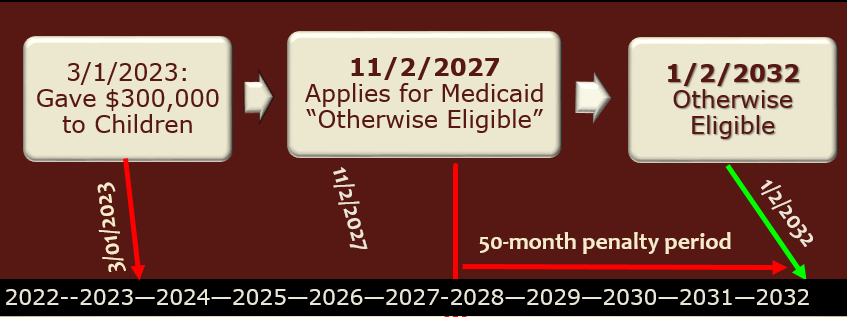
Current law looks back five years (30 months in California, which also restricts estate recovery in several other ways) at any transfers that were made without adequate “consideration”. If such transfers are found, the amount of such transfer is divided by the jurisdiction-specific average daily or monthly cost of care to determine how long the person must wait to qualify for Medicaid service. The following chart show how this works, assuming that the monthly cost of care is $6,000.
How the Partnership Helps
Because you have a LTCi policy, you are unlikely to need Medicaid to pay for your LTC. The government benefits in the ways described at the beginning of this article.
The purchaser of the policy also benefits by not having to qualify for Medicaid. But what if you are very unlucky and use up your LTCi policy and still need LTC? Partnership programs provide an additional back-end protection (additional to Medicaid) under such circumstances.
You can keep $1 of your ‘nest egg’ for every $1 you get from a Partnership-qualified LTCi policy. This concept is called “Asset Disregard” and also “Asset Protection”. Thus, you can qualify for Medicaid without having to spend that money first and that money is also disregarded by the state after you die. This is also described as “Dollar-for-Dollar”. Partnership policies in New York and some Indiana Partnership policies allow all assets to be disregarded (called “Total Asset Disregard”), even beyond the benefits paid by the Partnership LTCi policy.
The Partnership allows a LTCi policy to protect your money twice.
It pays for your care, saving you money
It allows you to avoid having to spend that money “down” to qualify for Medicaid.
In the example at the beginning of the article, the insured individual collected $418,836 from the LTCi policy, which then expired. Presuming that the person continues to need care, can they qualify for Medicaid?
If their countable assets are less than or equal to $420,836 and they satisfy above-mentioned qualification requirements, they can qualify for Medicaid immediately. The $420,836 figure reflects their $418,836 expenditure plus the presumed $2,000 jurisdiction-specific exclusion.
With $450,000 of countable assets, you’d have to spend $29,164 of your own money before you might qualify for Medicaid. That wouldn’t take very long.
What if you have $1,300,000 of countable assets? Then, you must spend $879,164 in addition to the $418,836 already spent (plus the amount you spent during the elimination period or because your monthly maximum benefit was insufficient or for non-covered services) before you could qualify for Medicaid.
Spending an additional $879,164 on your care is very unlikely. So, someone with $1,300,000 of countable assets is not likely to qualify for Medicaid. Furthermore, it would take years to spend that additional $879,164. During that period of time, your assets wouldn’t deplete quickly because of your social security, pension, and investment income, RMDs, etc. The $1.3 million in assets is likely to generate $40,000 to $65,000 of income. You’d also have to spend that additional income before you could qualify for Medicaid. That’s a HUGE amount. You’d likely die before spending so much.
This example should make it clear that the Partnership is not a boondoggle for the rich. Some critics think the rich somehow know exactly how much assets they’ll have so they can buy an amount of insurance that will be exactly what they need to allow all their assets to be disregarded. (This would also require that they know when they will need care and how much it will cost.)
Of course, people can’t predict such things accurately so there is an inefficiency in their LTCi planning as they will either buy too little or too much coverage.
More fundamentally, if the rich were so clairvoyant, they would have a huge amount of LTCi that they would be very unlikely to use up. And they’d still have to contribute their income to the cost of their LTC.
Thus, even such clairvoyant people would be unable to game the system meaningfully.
Although this example assumes that the Partnership policy had been totally depleted (expired), in most jurisdictions it is possible to qualify for Medicaid while the Partnership policy is still effective. If past claims create a total Asset Disregard that exceeds countable assets and the policy benefits are insufficient to cover the full cost of care, the policyholder may be eligible for Medicaid help.
In Indiana, Partnership-qualified LTCi policies qualify for a state income tax deduction, but non-Partnership LTCi policies do not qualify for that tax deduction. In other jurisdictions and with the Federal government, tax considerations are the same for Partnership and non-Partnership policies.
Partnership policy qualification requirements
To qualify for Partnership status, the policy must be tax-qualified.
They must also have numerous consumer protections, many of which are required for tax-qualified status and/or for LTCi policies by state regulation.
Legislators have wanted to assure that LTCi coverage stays meaningful as the insured person ages. Compounding the benefit by 5% each year (before claim and while on claim) is expected to do a good job of maintaining purchasing power. Therefore, a level premium 5% compound increase feature is a “safe haven”, guaranteeing that the policy will satisfy the compounding requirement.
Compounding according to a Consumer Price Index qualifies for Partnership except in Kentucky. Level premium 3% compounding qualifies except below age 75 in Idaho.
A provision which applies such compounding to premiums as well as benefits (i.e., is not a level premium approach) qualifies for Partnership status except in KY, PA and SD.
However, future purchase options which charge an attained age price for each slice of additional coverage generally do not qualify for Partnership status.
At least twenty-nine jurisdictions allow level premium 1% compounding to qualify for Partnership status. (AL, AR, AZ, CO, FL, GA, ID, KS, LA, MD, ME, MI, MN, MT, NE, NH, NM, NV, NJ, NC, ND, OK, PA, RI, SD, TN, TX, WV, WY. This can help low-budget buyers qualify for Partnership and also enable employers to pay for a core program so their employees have Partnership-qualified coverage. A higher percentage of policies will qualify for Partnership in the future if insurers and advisors leverage these opportunities. Currently only four insurers offer 1% compounding (CareScout, LifeSecure, Mutual of Omaha and Thrivent).
The original Partnership states (CA, CT, IN, NY) and South Dakota ($100/day) have minimum size requirements for Partnership policies. The original states’ size requirements increase, typically annually. Indiana’s 2025 requirement is low ($115/day) and if the coverage pool is at least $522,686 at issue, total asset disregard applies. The higher minimum size requirements in CA, CT and NY contribute to the lack of Partnership sales in those jurisdictions.
Advisor LTCi Certification
The DRA also established a requirement that agents selling Partnership policies have suitable training. The NAIC, in drafting a model Partnership regulation, required such training to sell all LTCi policies. It wanted to encourage all LTCi salespeople to have training.
Some states adopted the DRA wording while others adopted the NAIC wording, one way in which standards vary by jurisdiction. In states with the NAIC wording, certification is also required to sell linked-benefit policies with §7702B wording. Policies with chronic illness (§101g) wording, rather than §7702B “LTCi” wording, can be sold by agents who are not certified.
Most states require 8-hour training up-front and 4-hour renewals every 2 years. Doing such training in one state is sufficient to qualify in all such states. However, some states have unique training requirements. The original 4 Partn ership states (CA, CT, IN and NY) have their own training requirements. CO requires 16-hour training up-front and 5-hour renewals for domestic agents. Several states (such as GA,MA, MN, SD, VA, VT, WI) require a one- or two-hour supplement that addresses state-specific Partnership and/or Medicaid rules. (In these states, the basic training is accepted, but the supplement is required.)
Although certification renewal every two years is standard, the measurement of the two-year period varies by jurisdiction. Many jurisdictions require that the training be done once in every renewal licensing cycle. In such states, an agent might remain qualified to sell LTCi even if they have gone nearly four years without re-certifying. (They could have taken the certification class early in one cycle, then late in the next.) However, some insurers balk at accepting applications if the agent has not taken the certification class in the two-year period prior to the date the application is signed.
Twenty-one states require that re-certification occur within two years of the previous certification. In these jurisdictions, if an agent takes the certification class earlier than necessary, they have to take every future re-certification class earlier.
An agent’s failure to maintain certification can be damaging to the agent’s clients. Insurers fear being fined if they accept an application from an agent whose certification is out-of-date. Thus, they require the agent to get certified, then take a new application. The following problems can occur:
A health change may can the applicant to no longer be insurable or to be placed in a less favorable class.
The client may have had a birthday that causes them to be too old to qualify for coverage.
An age change can cause the applicant to have a higher premium forever into the future.
A product may no longer be available or may have become less attractive.
The applicant may no longer be married or may get fewer years of tax break.
The applicant will have lower benefits at claim time because compounding will be delayed and perhaps one less future purchase option may be offered prior to claim.
Some benefits, like survivorship and sometimes return of premium on death, require that the policy have been in force for 10 years. An applicant may end up not qualifying for such a benefit because of the later date of the second app.
The client also has the nuisance of a new app.
In addition to the client problems and potential liability, delay can also be a nuisance for the broker because it can require taking the 8-hour class again (Illinois requires a new 8-hour exam if renewal occurs 12 or more months too late and Virginia requires a new 8-hour exam if renewal is just one day late.
Advisors can ask the state to put in writing that, to avoid consumer disadvantage, it is OK for the insurer to accept the application despite certification having been completed after the date of the application. With such assurance, insurers will sometimes accommodate the applicant.
Partnership Success
Prior to the Deficit Reduction Act, Partnerships for long-term care insurance were available only in CA, CT, IN, and NY. Their success seems clear because 13.2% of the individual LTCi policies in the USA were sold in those 4 Partnership states in 1993, before the Partnerships were effective, but 19.4% of the policies in 2007 (and 24.1% of the premium) were sold in those states. What would have caused that increased market share other than the Partnerships?
However, since then, LTCi has become much more expensive. The Partnership target market has a much tougher time trying to afford coverage.
The table below shows, for each jurisdiction, the percentage of 2024 sales that qualified for the Partnership and the average premium per insured (for all policies and just for Partnership policies; these average premiums are distorted by including FPOs and 100% of single premiums).
Traditionally, north central states such as Minnesota, North Dakota, and Wisconsin have had a high percentage of policies qualify for Partnership. The restrictive requirements of the four original Partnership states has resulted in no Partnership sales being reported in 2024 in California, Connecti
Jurisdiction
% qualified
Average Premium including FPOs and full Single Premium
For Partnership
Total
Partnership
Alabama
20.1%
$5,139.29
$3,829.03
Alaska
0.0%
$5,008.13
Arizona
39.1%
$4,916.26
$6,288.26
Arkansas
19.5%
$4,514.11
$5,707.61
California
0.0%
$5,085.68
Colorado
32.7%
$5,192.62
$5,110.70
Connecticut
0.0%
$4,942.90
District of Columbia
0.0%
$4,826.74
Delaware
17.2%
$4,254.30
$4,464.19
Florida
20.0%
$3,800.33
$3,969.00
Georgia
43.5%
$5,010.28
$5,896.17
Hawaii
0.0%
$3,542.03
Idaho
27.3%
$5,177.34
$5,543.61
Illinois
25.7%
$6,026.78
$5,402.07
Indiana
2.2%
$4,361.52
$4,345.00
Iowa
48.7%
$4,619.13
$5,781.95
Kansas
35.3%
$3,677.07
$4,739.14
Kentucky
20.2%
$3,668.27
$6,870.04
Louisiana
31.3%
$4,581.23
$6,733.14
Maine
13.2%
$4,140.79
$4,881.78
Maryland
29.5%
$5,079.68
$4,002.57
Massachusetts
0.0%
$6,509.52
Michigan
23.5%
$3,615.51
$3,716.26
Minnesota
62.2%
$4,453.43
$5,257.07
Mississippi
0.0%
$5,973.75
Missouri
19.6%
$4,135.87
$5,537.02
Montana
31.5%
$3,763.96
$4,294.08
Nebraska
47.9%
$4,596.42
$6,018.41
Nevada
44.7%
$3,873.18
$4,236.62
New Hampshire
24.4%
$4,479.23
$3,690.45
New Jersey
15.4%
$3,958.01
$5,343.11
New Mexico
12.8%
$6,205.18
$4,358.84
New York
0.0%
$6,025.40
North Carolina
37.6%
$4,326.59
$6,417.17
North Dakota
62.0%
$4,296.13
$4,653.20
Ohio
55.1%
$4,949.35
$6,113.57
Oklahoma
35.3%
$4,638.05
$6,987.64
Oregon
51.8%
$6,650.21
$8,533.18
Pennsylvania
19.6%
$4,802.45
$4,534.44
Puerto Rico
0.0%
$874.83
Rhode Island
28.2%
$4,361.46
$6,855.65
South Carolina
35.3%
$4,141.82
$5,935.71
South Dakota
51.1%
$6,506.58
$7,089.57
Tennessee
38.6%
$4,700.81
$6,851.20
Texas
19.7%
$3,888.70
$3,912.12
Utah
0.0%
$5,462.42
Vermont
0.0%
$5,381.62
Virginia
30.6%
$4,568.10
$6,437.06
Washington
27.2%
$4,134.90
$4,578.07
West Virginia
8.8%
$2,853.16
$3,063.89
Wisconsin
62.8%
$5,023.45
$5,697.89
Wyoming
30.8%
$5,350.37
$10,871.57
Total
26.9%
$4,654.18
$5,499.52
Participants reported Partnership sales in 41 states, all Partnership-authorized states except CA, CT and NY. Only one insurer sells Partnership in IN; that insurer issued Partnership policies in 41 states. One insurer issues no Partnership policies.
Overall, 26.9% of policies qualified for Partnership, but 33.5% of policies qualified for Partnership in the DRA states (38.9% excluding Bankers’ Fundamental Plus product). Excluding Bankers’ Fundamental Plus product, 80% of Minnesota’s policies and 74% of Wisconsin’s policies qualified for Partnership, but 5 DRA states had less than 20% qualify.
Partnership programs could be more effective if:
Advisors offer small maximum monthly benefits more frequently to middle-income individuals and stress the importance of benefit increases to maintain LTCI purchasing power and qualify for Partnership asset disregard. For example, a $1,500 initial maximum monthly benefit covers about 1.5 hours of home care per day and, with compound benefit increases, may maintain buying power. Many middle-income individuals would like LTCI to help them stay at home while not “burning out” family caregivers and could be motivated further by Partnership asset disregard. (This approach does not work in CA, CT, IN and NY because of their high Partnership minimum daily benefit requirements.)
The four original Partnership states migrate to DRA rules. That would make it easier for policies to qualify for the Partnership in those four states and would create more uniformity. Uniformity would simplify the process for agents and general agents and encourage Partnership sales in multi-jurisdiction employer sales.
AK, HI, MA, MS, VT, and DC adopt Partnership programs.
Programs that privately finance direct mail educational LTCI content from public agencies were adopted more broadly.
Financial advisors press reluctant insurers to certify their products and offer 1% compounding.
More financial advisors were LTCI-certified. Some people argue that certification requirements should be loosened. Certainly re-certification rules could be improved in some jurisdictions.
Linked-benefit products became Partnership-qualified.
All Partnership jurisdictions honored asset disregard accumulated in other jurisdictions. The DRA established reciprocity unless a state opted out and permits states to opt out in the future even if they recognize reciprocity today. Except for California and for New York relative to policies not approved in NY, states with Partnership programs currently grant reciprocity to asset disregard from policies issued in other jurisdictions.
Reciprocity in agent certification was more common. California does not recognize out-of-state certification.
All states guaranteed asset disregard. Some states retain the right to deny asset disregard at any time in the future, including disavowing past asset disregard accumulations. I am not aware that such uncertainty has harmed the market, but ‘bait and switch’ practices are unbecoming. Ironically, a state which guarantees asset disregard requires that applicants be notified that asset disregard is not guaranteed. (This happened because they copied the disclosure requirement of a state that does not guarantee asset disregard.)
The employee benefits market isn’t what it used to be, and that’s good news for forward-thinking brokers.
As demographics shift and the Medicare-eligible population explodes, more employers are looking for ways to support older workers and retirees. At the same time, brokers who once stayed narrowly focused on group health are beginning to see the senior market not as a separate vertical, but as a natural extension of the value they already provide.
The message in 2025 is clear: Senior benefits aren’t niche anymore. They’re strategic.
The Demographic Surge Brokers Can’t Ignore
By 2030, every Baby Boomer will be age 65 or older. In fact, more than 11,000 Americans are turning 65 every day.1 And many aren’t retiring at 65 either. People are working longer, and they’re expecting benefits that reflect their needs.
Medicare Advantage enrollment continues to rise, with over half of all Medicare-eligible beneficiaries now enrolled in MA plans. As plan design, supplemental benefits, and carrier competition heat up, brokers who understand this space can offer real value, especially when clients are navigating post-65 transitions or retiree carve-outs.
This isn’t just about seniors. It’s about families, too. Many employees are caregivers for aging parents. Being able to speak to Medicare, supplemental plans, and long-term care options strengthens your client relationship beyond open enrollment.
Why the Senior Market Makes Strategic Sense
For brokers who have built careers around employer-sponsored coverage, expanding into senior benefits offers more than just a new revenue stream. It creates continuity.
Here’s what it unlocks:
Retiree solutions for employers looking to offload post-65 benefits while still supporting valued former employees.
Medicare navigation for older employees transitioning off the group plan, especially important as more employers seek a clean break at age 65.
Caregiver support tools that resonate with HR teams aiming to help employees manage aging family members’ coverage.
Competitive differentiation in an industry where value-added services win renewals and referrals.
In short, senior benefits give brokers a way to stay in the conversation as employee needs evolve.
The Mistake Most Brokers Make? Waiting
Too many brokers view the senior market as “later”. Something they’ll get around to when their book starts to age out.
But by then, the opportunity has passed. The broker who helped your client’s employee transition to Medicare? That’s the broker they’ll refer to friends and family. That’s the broker your client will remember when it’s time to design a retiree strategy.
The opportunity is now, and it’s growing.
What 2025 Clients Are Asking For
Employers today are balancing five generations in the workforce. The playbook that worked five years ago no longer cuts it.
What employers want now:
Clear guidance on retiree benefits—especially how to phase out costly group coverage without leaving former employees stranded.
Help managing aging workforce transitions, including how to integrate Medicare education and offboarding.
Holistic support for caregivers, many of whom are in HR’s blind spot.
Partnerships that extend beyond renewal season.
This is where brokers with senior benefits expertise stand out. You’re not just reacting to rate hikes. You’re helping clients build long-term strategies.
How to Get Started (Without Getting Overwhelmed)
You don’t need to become a Medicare expert overnight. You just need the right partners.
Many general agencies, like BenefitMall, offer dedicated support for brokers entering the senior space. From quoting platforms to compliance insights to marketing tools, you can get up to speed without starting from scratch.
Keep in mind: selling Medicare plans requires proper certification and annual compliance training, but with the right support, it’s easier to get started than you might think.
Key areas to focus on:
Medicare Advantage and Medicare Supplement basics
Prescription drug plan options
Special Enrollment Period (SEP) timing and rules
What to say (and not say) when discussing Medicare with clients
The best brokers don’t try to do it all themselves but build networks that make them smarter, faster, and more credible.
Bottom Line: Be the Broker Who’s Ready
The senior market isn’t a trend. It’s a demographic reality, and a growth channel brokers can’t afford to ignore.
By integrating senior benefits into your offering now, you:
Future-proof your book of business
Deepen client trust and loyalty
Open new referral paths and revenue streams
Differentiate yourself in a crowded market
At BenefitMall, we work with brokers across the country to build smart, sustainable senior strategies that meet the moment. Whether you’re starting fresh or looking to expand your offering, we’re here to support the pivot with the certification, tools, and support you need.
In 2025, it’s not about selling Medicare plans. It’s about being the advisor your clients need at every life stage, for every workforce challenge. Reach out to our team today to learn more.
The life insurance industry is at a pivotal crossroads. For decades, the brokerage channel thrived by building personal relationships, navigating complex underwriting processes, and managing paper-driven applications. However, as consumer expectations shift toward instant gratification and digital convenience, life brokerage agencies must innovate to stay competitive.
Technology adoption is no longer optional—it’s essential. Agencies that integrate smart digital solutions are seeing higher placement ratios, shorter sales cycles, and better client retention. From e-Applications and electronic policy delivery to data-driven underwriting and consumer portals, innovation is helping agents streamline the client journey while preserving the personal touch that distinguishes independent distribution.
Yet, despite the proliferation of insurtech tools, many agencies struggle to find platforms that truly align with their business model. The reality is, most digital tools are designed either for carriers’ direct-to-consumer initiatives or large call centers—not for independent agents and BGAs who build their businesses on trust and relationships. What life brokerage needs are solutions that combine the best of both worlds: the speed and simplicity of digital sales with the personalized, collaborative experience that clients still demand.
Key Trends Driving Innovation
Several key trends are reshaping the landscape for life brokerage agencies:
Instant Underwriting: Advanced algorithms and big data analytics enable instant decision-making, significantly reducing the time from application to approval.
End-to-End Digital Platforms: Fully integrated systems from quoting to e-policy delivery eliminate the inefficiencies of paper-based processes.
Data-Driven Personalization: AI tools analyze client information to offer tailored product recommendations, improving client satisfaction and placement rates.
Client Self-Service Options: Digital portals allow clients to initiate applications or manage policies independently, freeing agents to focus on relationship-building.
Enhanced Agent Tools: Platforms now offer CRM integration, lead scoring, automated follow-ups, and campaign management to help agents grow their practice efficiently.
Behavioral Science in UX Design: User-friendly, intuitive platforms designed with behavioral insights reduce abandonment rates and encourage full client disclosure.
Cybersecurity and Compliance: Strong encryption, digital consent management, and regulatory compliance features protect client data and ensure legal adherence.
Barriers to Innovation Adoption
Despite the clear benefits, many agencies hesitate to adopt new technology. Common barriers include:
Cost Concerns: Initial investment in new platforms or retraining staff can be perceived as prohibitive.
Change Resistance: Established workflows and legacy mindsets can slow technology adoption.
Fragmented Solutions: Agencies often face a confusing array of tools that don’t integrate smoothly.
Trust Issues: Fear of losing the personal touch or being displaced by technology can cause reluctance.
To overcome these challenges, it’s crucial for agencies to choose solutions specifically designed to enhance, not replace, the agent-client relationship.
Case Study: InstaBrain—A Platform Built for Agents
One example of innovation aligned with brokerage needs is InstaBrain, InstaBrain.io, a platform that blends cutting-edge automation with agent-centric design.
InstaBrain offers a 100% digital experience: real-time quotes, instant underwriting decisions, e-application completion, and electronic policy delivery—all within a matter of minutes. For independent agents and BGAs, InstaBrain provides a turnkey solution that preserves their brand and relationships while enabling digital transformation.
Technology and Underwriting Innovation
The engine behind InstaBrain’s speed and accuracy is its proprietary underwriting system known as “The Brain.” This sophisticated rules engine analyzes over 10,000 data points to deliver underwriting decisions in as little as 10 minutes—no medical exams required.
A recent upgrade, code-named Synapse, supercharges the platform with predictive modeling capabilities, offering smarter risk assessments and broader approval rates. If a client doesn’t qualify for a preferred risk class, the system pivots to offer alternate products automatically.
The Human Touch: KickIt Collaborative Application
InstaBrain’s standout feature is KickIt™—a co-browsing capability that allows agents to join a client’s application process in real time. This ensures that clients receive professional support without losing the convenience of a digital journey.
Product Diversity and Agent Empowerment
InstaBrain offers a range of instant-issue solutions, including:
InstaBrain Term (term life with living benefits)
Guaranteed Issue Whole Life
Accidental Death Benefit
Disability and Critical Illness Policies
Agents benefit from white-labeled portals, custom client experiences, and tools designed to drive higher completion rates and client satisfaction.
The Future of Innovation in Life Brokerage
Looking ahead, several trends are poised to further transform the brokerage space:
Embedded Insurance: Life insurance offerings integrated into other financial services platforms.
Voice-Activated Services: Applications and quotes initiated through voice assistants.
Predictive Client Outreach: Using AI to anticipate client needs based on life events and financial changes.
Decentralized ID Verification: Blockchain-based verification could streamline the underwriting process even further.
Forward-thinking agencies that embrace innovation while maintaining their human touch will thrive. The goal is not to replace the agent but to empower them with tools that make the process faster, smarter, and more client-centric.
Building a Roadmap for Digital Transformation
Successful innovation requires a deliberate strategy. Agencies should start with a clear vision of how technology can enhance their specific business model and client relationships. This means evaluating platforms not only for their features but also for their alignment with agency values, client demographics, and long-term goals. Investing in staff training and client education ensures a smoother transition and higher adoption rates. Regularly reviewing emerging technologies and maintaining flexibility to adapt as market demands evolve is equally critical. An incremental, phased approach to digital adoption often works best, allowing agencies to learn, optimize, and scale new capabilities thoughtfully.
Collaboration Between Technology Providers and BGAs
Another crucial factor in the innovation journey is the collaboration between BGAs and technology providers. Solutions that succeed are often those where developers actively seek feedback from the field, listening to agents’ and agencies’ real-world experiences and pain points. When platforms are co-created or refined based on direct user input, adoption and satisfaction soar. Technology must not be a top-down mandate; instead, it should feel like a partnership in growth and success. BGAs should seek vendors who offer not just software, but ongoing support, compliance resources, marketing enablement, and educational materials that empower agents to maximize digital tools.
InstaBrain is one example of a platform built with these principles in mind, but the broader message is clear: The future of life brokerage is digital, personal, and driven by innovation. Agencies that lean into these changes today will be the leaders of tomorrow.
We hope everyone had a great holiday season and a Happy New Year! This is one of the best times of the year to review business successes and some not-so-successes of the past year and do some planning for the year to come. When it comes to your discussions about disability income planning, how do you feel?
How was your year 2024 when it came to sharing awareness about disability insurance with your clients? Well, it probably depends on what area of insurance you are most focused on every day. So let’s go through some of the different areas of focus that we tend to see with producers.
Employee Benefits Producers: Were you able to discuss with clients how the caps in group LTD can reduce the percentage of income covered for the high income earners? For example, when a member of a group LTD income exceeds the maximum cap, then the net effect is a lower percentage of income being covered. So instead of those member(s) getting the full percentage of income covered, the cap will reduce the true percentage of income covered. An individual disability policy can help to close some or all of that coverage gap. If you weren’t able to discuss this concept in 2024, then let’s think of the LTD clients you helped in 2024 and which ones had members whose income exceeded the cap as listed in the LTD policy. This creates a great opportunity to discuss this gap throughout 2025.
Life Insurance Focused and Personal lines Producers: Go back through 2024 and think about the clients you met with about their life insurance planning. Were you able to also talk about how life insurance planning can be loss of income planning? In reviewing a family’s income planning, it’s important to understand and plan for a loss of either spouse’s income. The loss of income is key in this planning. If the loss of income is due to one’s passing, then the life insurance can be an essential planning tool to replace that lost income. You’ve probably had these conversations dozens and dozens of times throughout the year. Were you able to continue the conversation beyond the loss of income due to a spouse passing? Sometimes having a spouse unable to work due to a serious injury or sickness can be even more economically straining for the family. When a spouse can’t work, then their earned income will usually end up stopping as well. This is why disability insurance planning goes hand in hand with the life insurance planning that is designed to replace income. If you weren’t able to talk to those clients about disability income planning, then there’s a great opportunity to call them on or before the life insurance policy anniversary or when doing a follow up from the recent life insurance purchase.
Commercial Lines / Life Producers / Employee Benefits and those that work with business owners: If you go back through 2024 and think about all those sales opened or deals closed during lunches, golf or hunting outings, dinners and office visits to your business owner clients, were you also able to suggest a meeting about business disability planning? If not, you’ll have time to make it one of your goals in 2025. Think about the businesses you insure in which your client is so important to the business, that if they were unable to work the business could collapse. For example, a dentist, accountant, engineer, architect, interior designer, veterinarian, attorney or store owner, etc. When a client is a business owner that is the main creator of revenue for a business, then there’s added risk to the business. Regardless of if that business owner can’t work due to a disability, the expenses of the business will still roll in. Payroll still needs to be paid, the rent, utilities, and all the other fixed expenses need to be organized and paid. If you weren’t able to talk about Business Overhead Expense insurance, then you have a great opportunity throughout 2025.
All areas of focus: Business Continuation Insurance is a topic in many fields of insurance. How does the business continue if an owner suddenly passed away? If the call tomorrow was that the owner passed, what is the business continuation plan? If there’s an explosion at a business, how is that business going to be rebuilt and what type of P&C insurance did you recommend? Were you able to touch upon the same planning concept if one of the owners were to end up disabled, they were never able to come back to work or even communicate in the future? Most buyout agreements have provisions in case a partner becomes disabled, but most don’t have it funded with disability buyout insurance. If you were unable to talk to your clients about having a disability insurance buyout review, to make sure all is up to date, then you have a great opportunity this year to have that discussion. In addition, you can talk to them about any key people in their office that create substantial revenue for the business. When you ask a client how important they are to the business, they may know they are the most important or they may explain how they mentored or brought in someone else, and they are the key person that drives revenue. If the latter is the case, then there’s additional risk to the business if the key person was unable to work. This gives you the ability to suggest a further conversation about key person disability insurance.
Remember that planning for what occurs if a client is unable to work due to a disability is so important for everyone.
Twas the week before Christmas and all through the house, Not a creature was stirring, not even a mouse, I was warm and snug tucked inside my bed, When my brain clicked on, filling my head, With these thoughts that I wish to espouse.
For the past eight years, Broker World magazine has kindly been an outlet for many of my professional articles. Over the years I have received many generous and insightful remarks from readers that have served to validate my efforts and to genuinely make me feel that the efforts were appreciated.
In that vein, I want to in turn thank all the BWM readers who have recently taken the time to e-mail, text, or even telephone me with kind words about the poignant nature of my last article, offering shared health experiences, and even some medical advice!
For those who may not recall, or may have missed it, in my last article, entitled The Healthiest Guy In The Hospital, I recounted the events surrounding my very surprising and near-fatal “widow-maker” heart attack of September 10, and the challenging aftermath of the ensuing weeks.
As an update, I am pleased to report that the thrice-weekly Cardiac Rehab is going well, and that my wife and I are both adjusting to my full retirement (October 30th) from the long term care insurance industry.
What I did not realize at the time that I penned the article is that, in addition to the obvious challenges attached to the physical recovery after such a traumatic event, the tremendous psychological aspect takes on a life of its own.
To this end, on Black Friday, I acquiesced to encouragement from my family and bought a new Apple watch. Not because I wanted to check email or answer my phone and texts, but because of the cardiac features. My watch measures how many beats per minute my heart is pumping, and when I get errant chest pain, I can even give myself a one lead EKG to eliminate any fear of atrial fibrillation. Yikes.
A few newfound truths:
Forget about FOMO–fear of missing out–the new Fear–FOODI–centers around simply “fear of over doing it” because when I do, there is a price to be paid. Superman has left the building.
Sleep has taken on greater priority, and the chronic fatigue is still in evidence three months after the event. The rare pre-event 10–15-minute power nap has yielded on most days to a more proper 45–90-minute siesta or I am a narcoleptic zombie by dinner time.
My pre-event perfect blood pressure is now incredibly low, which means that I am now perpetually cold and wearing heavy sweatshirts or sweaters around the house. This also accounts for the fatigue as well.
Because of the blood thinners, I bruise as easily as a peach and am usually sporting unexplained bruises all over my body. I contemplated asking Santa for a bubble wrap body suit.
Reading labels for sodium and saturated fat content at the grocery store is a real drag and downer.
Despite these newfound truths, they all beat the alternative and every day truly is a gift…that is why it is called the Present.
During this season of gratitude and giving thanks, I want to express my thanks to my good friends and partners at Krause Financial for their wise encouragement of my medical retirement and focus on my recovery and quality time with my family. I again express gratitude for the medical skills that saved my life, for the exceptional caregiving [and hovering] of my family, and for all of you who have expressed good wishes. Best wishes for a prosperous and healthy 2025!
After the Luftwaffe had thrown all its hatred of free thinking against an indomitable British spirit there were voices of derision and submission to the overwhelming perception of decimation and potential failure. Winston made it crystal clear. It was not the beginning of the end, it was the end of the beginning. I promise I will only tie a ribbon on this once. The optimism of this column is at this point legendary. We have all worked with the materials that were available at the time. I do not believe that anyone would claim comprehensive market success. Even conservatively we have been reaching for 25 to 35 percent as a definition of market success. Depending on how you hold the numbers up to the light we are at seven to 10 percent and currently 17 million Americans do hold some form of insured protection against the onslaught of financially devastating custodial care. It is also necessary to argue that this frequently tossed around market penetration data is inherently flawed. It can be argued, for example, mid-west markets where fear of losing the farm is crystal clear in the majority of minds has greater sales numbers. Geographic enclaves where education and economic success flourish statistically may also have higher numbers of sales success. The market has always had its goldilocks boundaries excluding those who have the privilege to prefer to self-fund and not counting those where government dependence will ultimately be the only alternative .
At the absolute heart of any retroactive conversation must be acknowledgement on an entrenched affordability component. The price of this problem is the issue .Our greatest sales success 20 to 25 years ago was driven by premium cost, both individual and group, that was frankly “doable.” As the market matured excessive medical inflation, still growing at a projected five to six percent, unprecedented love of the ownership of those who did buy and the inevitable overly aggressive benefit battles have brought us all full circle:
After paying many millions in claims we do know what will happen and when and what the cost looks like in great minutia.
We are simply not alone. The earth is suffering a deficit of adequate care for an aging population. The first to take to the streets in Russia, Turkey or France are the pensioners on a fixed income. Reducing Medicare and Medicaid is political suicide in America and no one goes willingly to a Nursing Home.
The solution has always been a combination of public and private solutions. You will receive care, period. The only open question remains the same—”What will be the quality and degree of control you will have of that care?” This is the firm ground we stand on every time we ask the ultimate ice breaker—“What are your plans to handle the cost of long term care?”
We simply have to accept the reality of the cost of our growing pains. We speculated on a future that materialized much differently than projected. There is not an experienced insurance professional who does understand the trajectory of new health product. Even though we did take aim at the issue as early as 40-50 years ago, the solidification of structure from HIPAA and NAIC Model Regulations gave us a clear track to run on and initially we did. We all knew or at least may have suspected that we were underpriced with very limited clam information. If pressed we might also have worried that a virgin health product might ultimately create reserve drains. Within 24 months of the advent of TQ products, companies flooded into the market. All would not survive, We underpriced and surprise (not) claims spiked in unanticipated locations, persistency exceeded all expectations, new premiums coming in the front door began to diminish, Regulatory authorities were less than cooperative with needed premium increases. Like the perfect storm, fronts were moving in from multiple directions.
It can be argued that as new premium increases also began to grow we unintentionally abandoned the market that had given us the best success. The middle class, particularly its upwardly mobile components, found itself priced out of the party. Those most exposed to the risk. Those who could run out of money watched the ship sail out to sea without them.
And finally, insult to injury, onerous rate increases got on everyone’s boots.
I have spent 20 years in this column expressing my belief in a sure and certain path forward.
I’ll let Winston sum it up: “The pessimist sees difficulty in every opportunity .The optimist sees the opportunity in every difficulty.“
College has become the single largest investment for American families, and for some, the costs associated with funding higher education go beyond the sticker price of tuition. While families increasingly realize the threat of rising college costs, the overlooked scope, and scale of its effects are arguably even more detrimental as parents nationwide sacrifice their own retirement stability to fund their child’s academic pursuits. This is the unfortunate reality of Americans nationwide, but luckily, college planning services are on the rise to mitigate these challenges.
Qualified college planners are vital in today’s environment because of their unique ability to address college funding concerns and the dilemma of selecting the best schools for students and parents. After working with a college planner and selecting the colleges you will apply to, the question, “How do I pay for college without going broke?” inevitably comes into play. Essentially, there are only five ways to pay for college: federal loans, private loans, qualified assets, home equity, and cash flow/nonqualified assets. However, government rules per the FASFA application list out which assets are exempt and ultimately do not raise your Expected Family Contribution (EFC)/Student Aid Index (SAI) scores. These include whole life insurance, annuities, and index universal life insurance (IUL). Compared to whole life insurance and annuities, IUL can have many moving parts, so it is crucial to ensure that your college plan is designed correctly for you and your child.
Unfortunately, there is no perfect, one-size-fits-all solution for all families. Every option has pros and cons and will affect each family differently in the future. For example, some families might need strong guarantees of a whole-life policy in the early years. Others might need a solution for sheltering some extra assets outside the plan, requiring the funds to be fully liquid once the student graduates. Some families might need indexing options that could provide a higher rate of return and help supplement future retirement income.
If you have investigated college funding plans before, you may wonder why a 529 plan has yet to be mentioned. A 529 plan could be a sufficient college funding vehicle for some, but the restrictions of a 529 could prevent many families from receiving financial aid awards. Additionally, a 529 is not a plan. It is an investment product, however, a 529 can still be incorporated into a great college plan design. Nevertheless, every family has unique needs and requires a unique holistic financial plan to pay for college without sacrificing their future retirement income. An IUL could be a strong option for many families. Before purchasing a policy, it is important to understand how it can provide supplemental income in retirement, the fees associated with IUL, and why a properly managed portfolio is not a sufficient alternative for paying for college.
One of the biggest advantages of IUL is the longevity of the funds and the ability to use those funds later in life to supplement retirement income. When comparing a properly designed college IUL to a managed portfolio, the money coming out to cover the tuition and/or loans should be the same as the managed portfolio. The key difference is how long it will last during retirement. Most IULs have different options to access the cash value but, for college planning, an index/variable loan feature is my preference.
The main advantage of using a variable/index loan option is that the money pulled out to cover college expenses is still in the IUL indexing strategies and earning a full rate of return based on indexing performance. This is why when we compare the IUL college plan to a managed portfolio. When designed correctly the IUL will last past age 100 while the managed portfolio runs out of income on average when the client is in their late 60s to early 70s, assuming the same ROR between the IUL and managed portfolio. With this incredible longevity, IUL can be an advantageous source of supplemental retirement income.
While the longevity of the funds is highly beneficial, this benefit within an IUL comes at a small cost in the form of loan fees. It varies from company to company but, on average, it should be around a five to six percent loan fee. The overall fees in an IUL are essentially front loaded, which allows the fees to be pennies on the dollar when the clients are in their retirement years. Most well-managed portfolios have fees from one to two percent which has been the average rate for the past decade.
To compare this cost with a managed portfolio, it is easiest to compare the fees in 10-year segments. The first 10-year segment will be the most expensive because IUL fees are front-loaded, but once you get past the first 10 years the fees start declining. The second 10-year segment is where I see most fees are about the same or slightly less than the comparison managed portfolio. The third 10-year segment and beyond is when on average the fees should be 1/3 to 1/2 the cost compared to the managed portfolio, again, if the IUL was designed correctly.
Although some falsely claim that the IUL expenses will be the highest once the client starts taking their retirement income, the fees within an IUL are less when the clients are in their 60s, 70s, and 80s compared to a managed portfolio that charges one to two percent. When comparing overall dollars spent, the typical cost savings are significant and often total upwards of several thousand dollars. This means more of your money is in the plan earning a rate of return versus wrapped up in fees and ultimately spent. Although the front-loaded fee may seem intimidating, this bigger-picture view of IUL fees demonstrates how efficient this structure can be in the long run.
When comparing the total fees of the IUL with what it could hypothetically earn based on the indexing options, you can locate when your break-even point is. Most correctly designed IULs should have a break-even point between years three and six. Keep in mind that it is impossible and frankly illegal to provide a guaranteed rate of return of what each indexing option will provide. Most carriers will provide lookbacks on what their indexing option would have returned in previous years, but by no means is this a promise or guarantee of how it will perform in the future. Since these plans are designed to start paying off college loans between years three to five, the design itself needs to be more conservative. For example, I prefer to use an ROR of six to seven percent based on the proposed carriers’ fixed rate options.
It is important to note that having a properly managed portfolio is a great thing. I have a couple myself, but they are not beneficial for paying for college. They are not exempt from the financial aid formula, they have no protection against market volatility, most accounts are more expensive, and the money spent on college expenses is gone, which means your money is no longer earning a rate of return to help supplement future retirement income. A professionally managed portfolio is like having another great club in your golf bag. It could be a particularly important part of your overall financial planning and retirement planning success but should never be used to pay for college.
It is no secret that paying for college is not going to get any cheaper, and getting accepted into college is not going to get any easier. However, if you work with the right college planner they will be able to develop a personalized college funding plan which could utilize an annuity, a whole life insurance option, or an IUL. As the higher education landscape transforms, families need to consider alternative solutions. When remodeling a house, people hire professional contractors, plumbers, electricians, and other skilled workers because they know that, if they try to do it themselves, one mistake could have costly consequences. If you would hire a professional electrician to rewire your home so you do not get electrocuted or worse burn your home down, why would you not consider hiring a professional college planner so you do not risk financial catastrophe? If you or someone you know is struggling to find a way to help their child establish their future without risking their own, I encourage you to hire a college planning professional who can help you.