


Tuesday, August 18, 2026

State Long-Term Care Insurance Partnerships

0

Introduction

Funding long-term care (LTC) has been recognized as a huge issue for our country for a long time.  Insurers, regulators, politicians, providers, educators and policy wonks continue to seek solutions.

For the purposes of this article, let’s assume that a client age 55 buys a Partnership-qualified policy with an initial monthly maximum of $4500, 3% compounding and a 3-year benefit period after a 90-service-day elimination period.  Let’s assume the client begins to need qualifying care at age 85½, at which time her maximum monthly benefit would have risen to $11,044.  For convenience, I’ll assume the insured/claimant is female and her life partner (if any) is male.  If she uses the full amount each month, her LTCi benefits would be as follows:

Insurance Age at the Beginning of the Claim YearMaximum Monthly BenefitNumber of Months of Benefits PaidReimbursement of that Year’s ExpensesComment
85$11,0443$33,132Claim started at mid-year; 90-day EP; so only 3 months paid
86$11,37512$136,500
87$11,71712$140,592
88$12,0689$108,612
Total$418,836

The government benefits from that purchase of private LTCi in the following ways:

  1. The private insurance LTCi benefit of $418,836 likely kept the client off Medicaid or contributed to the cost of Medicaid care, saving money for both the Federal government and state government.
  2. For those kept off Medicaid, the state avoids the administrative cost of determining whether the insured is eligible for Medicaid, setting up records, and making payments.
  3. The state and Federal governments benefit because LTC providers get the full private pay rate rather than the reduced Medicaid rate.  Providers are therefore better able to provide outstanding service.  The more LTCi there is, the more likely it is that innovators will want to be in the LTC industry, providing new and better services.
  4. The additional revenue enables the provider to earn more profit and/or pay higher salaries.  Thus, the provider and/or its employees pay higher income taxes to the state and Federal governments.
  5. With LTCi, the client is likely to be less dependent on family care.  Thus, family members are likely to be more productive for society and to generate more income, which results in more income taxes for state and Federal governments.
  6. The insurance agent who sold LTCi will pay income taxes on his/her commissions to the state and Federal governments.
  7. The insurance company will pay premium tax to the state and income tax to the Federal government.

As noted in the above bullets, the insured person benefits, the insured’s family benefits, the providers and their employees benefit, insurance brokers and their families benefit, and insurers (and their employees and shareholders) benefit, as well as the state and Federal government.

The Robert Woods Johnson Foundation (Mark Meiners, in particular) brainstormed to find a way to protect the government from the LTC costs of an aging population.  What could the government do to encourage the middle class to buy more LTCi?  They developed a win-win-win-win-win-win concept to make private long-term care insurance (LTCi) more affordable for the middle class: State/Carriers Public Partnerships.  In a nutshell, State Partnerships are an additional back-end safety net to reward middle-class people for buying LTCi.

Four states (CA, CT, IN and NY) blazed the trail for Partnership programs in the early 1990s.  However, an aide to Congressman Henry Waxman incorrectly concluded that the Partnership was a boondoggle for the rich.  So, Waxman inserted into Federal legislation (OBRA, 1993) a provision prohibiting other states from developing future Partnerships.  The four existing programs (including his state, CA) were grandfathered.

Twelve years later, the Deficit Reduction Act of 2005 (DRA) removed the restriction, allowing more jurisdictions to create Partnership programs.  Now, 45 states have Partnership programs.  (Partnership policies are not available in AK, HI, MA, MS, or VT, nor in DC, Puerto Rico or Guam.  However, MA has a similar program called MassHealth Exemption.)  The original, grandfathered states’ provisions differ among themselves and also differ from the provisions of the other 41 “DRA” states.  There are also slight differences among the DRA states, most particularly relative to what types of compound benefit provisions can qualify for Partnership status.

Medicaid Eligibility in General

When our claimant applies to Medicaid for long-term care services, state reviewers determine whether she is eligible for Medicaid (“Medi-Cal” in California) LTC benefits.  The numbers in this section of the article apply in 2025, unless otherwise indicated.

  1. Any of her income in excess of $50/month (varies by state and may differ for home care) must be applied to the cost of care.  If that income is sufficient to cover her entire cost of care, she is not eligible for Medicaid.  Notes:
    1. Her spouse is entitled to his independent income (however, if he owns an annuity in payout mode that has a certain period or death benefit, the state must be identified as a secondary beneficiary.
    2. If her spouse is impoverished, she can transfer income to him to bring his income up to $2,555/month.  He can appeal to get as much as $3,948/month, so some jurisdictions (AK, CA, DC, GA, IL, IA, LA, MS, NV, NY, OK, SC, TX, WY) automatically permit up to $3,948 instead of $2,555.
    3. Some states have an “income cap” ($2,901/month) rather than determining whether the income is sufficient to cover the cost of care.  That is, if your income exceeds $2,901/month, you are ineligible for Medicaid LTC support.  People who can’t afford their LTC but who earn too much income can put excess income into a Miller Trust which pays their provider.  That brings their income within limits, qualifying them for Medicaid if they and their trust were unable to pay the full cost..
  2. In jurisdictions other than California, the care-needy individual must also apply “countable assets” in excess of $2,000 (in most states) toward the cost of care.
    1. Non-countable assets include:
      1. The person’s home (unless equity exceeds the amount shown below) if any of the following circumstances apply
        1. The person may return to the home
        2. The person’s spouse is living in the home
        3. The person’s child under age 21 or blind or permanently & totally disabled is living in the home
        4. A sibling is living in the home and resided in it for at least one year (while having an ownership interest) immediately before the person was admitted to the facility.
        5. A child is living in the home and resided in home for at least two years immediately before the person’s admission and provided care which permitted the person to stay home rather than be in an institution.
        6. The person is ineligible for Medicaid if home equity exceeds $730,000, except that the cap is $1,097,000 in CO, CT, DC, HI, MA, NJ, NY, and WA.   (CA does not impose this limitation.)  These limits are indexed each year.
      2. One automobile
      3. Household and personal belongings
      4. Wedding and engagement rings
      5. Income-generating property (because the income must be used to pay for care)
      6. Burial plot and prepaid burial plans 
      7. Cash value of life insurance if, and only if, the combined death benefit under such policies is less than 1500.
      8. Term insurance
    2. To be clear “countable assets” include:
      1. Cash above the limit ($2000 or so for single people; $3000 or so for a couple who both need care)
      2. Other liquid assets: CDs, T-bills, stocks, bonds, retirement accounts (Keough*, 4.01k*, IRA*, 4.03b, etc.).  Kansas is an exception in that the spouse’s §4.03B funds are exempt.
      3. Cash Value of life insurance if the combined death benefits exceeds $1500
      4. Vacation home
      5. Second vehicles

Medicaid Repayment

Federal legislation (Public Law 104-191) requires that Medicaid costs be reimbursed by the recipient’s estate (“estate recovery”).  When someone begins to need Medicaid support for LTC, the state may place a lien on that person’s home.  When exemptions eventually wear off (e.g., children or a spouse no longer live in the home), the government collects the cost incurred by Medicaid to enable us, as a country, to provide Medicaid support to other needy individuals.  Essentially, Medicaid LTC benefits are a long-term interest-free loan which is forgiven if there is no ability to repay.

The state is reimbursed for LTC services and related prescription drugs and hospital costs. The state may also recover any Medicare cost-sharing and non-LTC Medicaid costs.

Medicaid-planning attorneys help people protect assets for their beneficiaries (children or non-profits).  There is an on-going ‘cat and mouse game’ as attorneys find ways to protect assets and legislators and regulators plug what they perceive to be loopholes.

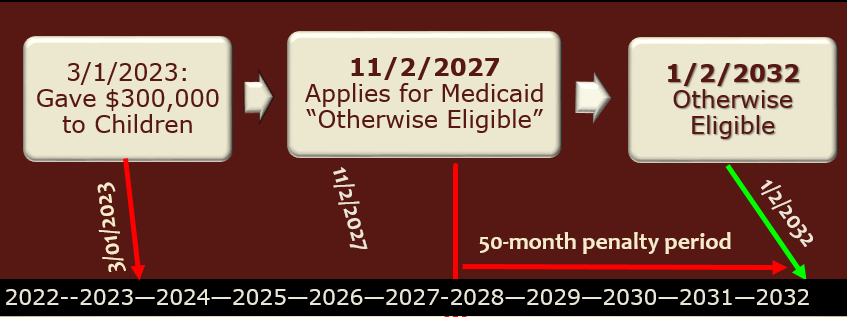
Current law looks back five years (30 months in California, which also restricts estate recovery in several other ways) at any transfers that were made without adequate “consideration”.  If such transfers are found, the amount of such transfer is divided by the jurisdiction-specific average daily or monthly cost of care to determine how long the person must wait to qualify for Medicaid service.  The following chart show how this works, assuming that the monthly cost of care is $6,000.
How the Partnership Helps

Because you have a LTCi policy, you are unlikely to need Medicaid to pay for your LTC.  The government benefits in the ways described at the beginning of this article.

The purchaser of the policy also benefits by not having to qualify for Medicaid.  But what if you are very unlucky and use up your LTCi policy and still need LTC?  Partnership programs provide an additional back-end protection (additional to Medicaid) under such circumstances.

You can keep $1 of your ‘nest egg’ for every $1 you get from a Partnership-qualified LTCi policy.  This concept is called “Asset Disregard” and also “Asset Protection”.  Thus, you can qualify for Medicaid without having to spend that money first and that money is also disregarded by the state after you die.  This is also described as “Dollar-for-Dollar”.  Partnership policies in New York and some Indiana Partnership policies allow all assets to be disregarded (called “Total Asset Disregard”), even beyond the benefits paid by the Partnership LTCi policy.

The Partnership allows a LTCi policy to protect your money twice.

  1. It pays for your care, saving you money
  2. It allows you to avoid having to spend that money “down” to qualify for Medicaid.

In the example at the beginning of the article, the insured individual collected $418,836 from the LTCi policy, which then expired. Presuming that the person continues to need care, can they qualify for Medicaid?

If their countable assets are less than or equal to $420,836 and they satisfy above-mentioned qualification requirements, they can qualify for Medicaid immediately.  The $420,836 figure reflects their $418,836 expenditure plus the presumed $2,000 jurisdiction-specific exclusion.

With $450,000 of countable assets, you’d have to spend $29,164 of your own money before you might qualify for Medicaid.  That wouldn’t take very long.

What if you have $1,300,000 of countable assets?  Then, you must spend $879,164 in addition to the $418,836 already spent (plus the amount you spent during the elimination period or because your monthly maximum benefit was insufficient or for non-covered services) before you could qualify for Medicaid.

Spending an additional $879,164 on your care is very unlikely.  So, someone with $1,300,000 of countable assets is not likely to qualify for Medicaid.  Furthermore, it would take years to spend that additional $879,164.  During that period of time, your assets wouldn’t deplete quickly because of your social security, pension, and investment income, RMDs, etc.  The $1.3 million in assets is likely to generate $40,000 to $65,000 of income.  You’d also have to spend that additional income before you could qualify for Medicaid.  That’s a HUGE amount.  You’d likely die before spending so much.

This example should make it clear that the Partnership is not a boondoggle for the rich.  Some critics think the rich somehow know exactly how much assets they’ll have so they can buy an amount of insurance that will be exactly what they need to allow all their assets to be disregarded.  (This would also require that they know when they will need care and how much it will cost.)

Of course, people can’t predict such things accurately so there is an inefficiency in their LTCi planning as they will either buy too little or too much coverage.

More fundamentally, if the rich were so clairvoyant, they would have a huge amount of LTCi that they would be very unlikely to use up.  And they’d still have to contribute their income to the cost of their LTC.

Thus, even such clairvoyant people would be unable to game the system meaningfully.

Although this example assumes that the Partnership policy had been totally depleted (expired), in most jurisdictions it is possible to qualify for Medicaid while the Partnership policy is still effective.  If past claims create a total Asset Disregard that exceeds countable assets and the policy benefits are insufficient to cover the full cost of care, the policyholder may be eligible for Medicaid help.

In Indiana, Partnership-qualified LTCi policies qualify for a state income tax deduction, but non-Partnership LTCi policies do not qualify for that tax deduction.  In other jurisdictions and with the Federal government, tax considerations are the same for Partnership and non-Partnership policies.

Partnership policy qualification requirements

To qualify for Partnership status, the policy must be tax-qualified.

They must also have numerous consumer protections, many of which are required for tax-qualified status and/or for LTCi policies by state regulation.

Legislators have wanted to assure that LTCi coverage stays meaningful as the insured person ages.  Compounding the benefit by 5% each year (before claim and while on claim) is expected to do a good job of maintaining purchasing power.  Therefore, a level premium 5% compound increase feature is a “safe haven”, guaranteeing that the policy will satisfy the compounding requirement.

Compounding according to a Consumer Price Index qualifies for Partnership except in Kentucky.  Level premium 3% compounding qualifies except below age 75 in Idaho.

A provision which applies such compounding to premiums as well as benefits (i.e., is not a level premium approach) qualifies for Partnership status except in KY, PA and SD.

However, future purchase options which charge an attained age price for each slice of additional coverage generally do not qualify for Partnership status.

At least twenty-nine jurisdictions allow level premium 1% compounding to qualify for Partnership status.  (AL, AR, AZ, CO, FL, GA, ID, KS, LA, MD, ME, MI, MN, MT, NE, NH, NM, NV, NJ, NC, ND, OK, PA, RI, SD, TN, TX, WV, WY.  This can help low-budget buyers qualify for Partnership and also enable employers to pay for a core program so their employees have Partnership-qualified coverage.  A higher percentage of policies will qualify for Partnership in the future if insurers and advisors leverage these opportunities.  Currently only four insurers offer 1% compounding (CareScout, LifeSecure, Mutual of Omaha and Thrivent).

The original Partnership states (CA, CT, IN, NY) and South Dakota ($100/day) have minimum size requirements for Partnership policies.  The original states’ size requirements increase, typically annually.  Indiana’s 2025 requirement is low ($115/day) and if the coverage pool is at least $522,686 at issue, total asset disregard applies.  The higher minimum size requirements in CA, CT and NY contribute to the lack of Partnership sales in those jurisdictions.

Advisor LTCi Certification

The DRA also established a requirement that agents selling Partnership policies have suitable training.  The NAIC, in drafting a model Partnership regulation, required such training to sell all LTCi policies.  It wanted to encourage all LTCi salespeople to have training.

Some states adopted the DRA wording while others adopted the NAIC wording, one way in which standards vary by jurisdiction.  In states with the NAIC wording, certification is also required to sell linked-benefit policies with §7702B wording.  Policies with chronic illness (§101g) wording, rather than §7702B “LTCi” wording, can be sold by agents who are not certified.

Most states require 8-hour training up-front and 4-hour renewals every 2 years.  Doing such training in one state is sufficient to qualify in all such states.  However, some states have unique training requirements.  The original 4 Partn ership states (CA, CT, IN and NY) have their own training requirements.  CO requires 16-hour training up-front and 5-hour renewals for domestic agents.  Several states (such as GA, MA, MN, SD, VA, VT, WI) require a one- or two-hour supplement that addresses state-specific Partnership and/or Medicaid rules.  (In these states, the basic training is accepted, but the supplement is required.)

Although certification renewal every two years is standard, the measurement of the two-year period varies by jurisdiction.  Many jurisdictions require that the training be done once in every renewal licensing cycle.  In such states, an agent might remain qualified to sell LTCi even if they have gone nearly four years without re-certifying.  (They could have taken the certification class early in one cycle, then late in the next.)  However, some insurers balk at accepting applications if the agent has not taken the certification class in the two-year period prior to the date the application is signed.

Twenty-one states require that re-certification occur within two years of the previous certification.  In these jurisdictions, if an agent takes the certification class earlier than necessary, they have to take every future re-certification class earlier.

An agent’s failure to maintain certification can be damaging to the agent’s clients.  Insurers fear being fined if they accept an application from an agent whose certification is out-of-date.  Thus, they require the agent to get certified, then take a new application.  The following problems can occur:

  • A health change may can the applicant to no longer be insurable or to be placed in a less favorable class.
  • The client may have had a birthday that causes them to be too old to qualify for coverage.
  • An age change can cause the applicant to have a higher premium forever into the future.
  • A product may no longer be available or may have become less attractive.
  • The applicant may no longer be married or may get fewer years of tax break.
  • The applicant will have lower benefits at claim time because compounding will be delayed and perhaps one less future purchase option may be offered prior to claim.
  • Some benefits, like survivorship and sometimes return of premium on death, require that the policy have been in force for 10 years.  An applicant may end up not qualifying for such a benefit because of the later date of the second app.
  • The client also has the nuisance of a new app.

In addition to the client problems and potential liability, delay can also be a nuisance for the broker because it can require taking the 8-hour class again (Illinois requires a new 8-hour exam if renewal occurs 12 or more months too late and Virginia requires a new 8-hour exam if renewal is just one day late.

Advisors can ask the state to put in writing that, to avoid consumer disadvantage, it is OK for the insurer to accept the application despite certification having been completed after the date of the application.  With such assurance, insurers will sometimes accommodate the applicant.

Partnership Success

Prior to the Deficit Reduction Act, Partnerships for long-term care insurance were available only in CA, CT, IN, and NY.  Their success seems clear because 13.2% of the individual LTCi policies in the USA were sold in those 4 Partnership states in 1993, before the Partnerships were effective, but 19.4% of the policies in 2007 (and 24.1% of the premium) were sold in those states.  What would have caused that increased market share other than the Partnerships?

However, since then, LTCi has become much more expensive.  The Partnership target market has a much tougher time trying to afford coverage.

The table below shows, for each jurisdiction, the percentage of 2024 sales that qualified for the Partnership and the average premium per insured (for all policies and just for Partnership policies; these average premiums are distorted by including FPOs and 100% of single premiums).

Traditionally, north central states such as Minnesota, North Dakota, and Wisconsin have had a high percentage of policies qualify for Partnership.  The restrictive requirements of the four original Partnership states has resulted in no Partnership sales being reported in 2024 in California, Connecti

Jurisdiction% qualifiedAverage Premium including FPOs and full Single Premium
For PartnershipTotalPartnership
Alabama20.1%$5,139.29$3,829.03
Alaska0.0%$5,008.13
Arizona39.1%$4,916.26$6,288.26
Arkansas19.5%$4,514.11$5,707.61
California0.0%$5,085.68
Colorado32.7%$5,192.62$5,110.70
Connecticut0.0%$4,942.90
District of Columbia0.0%$4,826.74
Delaware17.2%$4,254.30$4,464.19
Florida20.0%$3,800.33$3,969.00
Georgia43.5%$5,010.28$5,896.17
Hawaii0.0%$3,542.03
Idaho27.3%$5,177.34$5,543.61
Illinois25.7%$6,026.78$5,402.07
Indiana2.2%$4,361.52$4,345.00
Iowa48.7%$4,619.13$5,781.95
Kansas35.3%$3,677.07$4,739.14
Kentucky20.2%$3,668.27$6,870.04
Louisiana31.3%$4,581.23$6,733.14
Maine13.2%$4,140.79$4,881.78
Maryland29.5%$5,079.68$4,002.57
Massachusetts0.0%$6,509.52
Michigan23.5%$3,615.51$3,716.26
Minnesota62.2%$4,453.43$5,257.07
Mississippi0.0%$5,973.75
Missouri19.6%$4,135.87$5,537.02
Montana31.5%$3,763.96$4,294.08
Nebraska47.9%$4,596.42$6,018.41
Nevada44.7%$3,873.18$4,236.62
New Hampshire24.4%$4,479.23$3,690.45
New Jersey15.4%$3,958.01$5,343.11
New Mexico12.8%$6,205.18$4,358.84
New York0.0%$6,025.40
North Carolina37.6%$4,326.59$6,417.17
North Dakota62.0%$4,296.13$4,653.20
Ohio55.1%$4,949.35$6,113.57
Oklahoma35.3%$4,638.05$6,987.64
Oregon51.8%$6,650.21$8,533.18
Pennsylvania19.6%$4,802.45$4,534.44
Puerto Rico0.0%$874.83
Rhode Island28.2%$4,361.46$6,855.65
South Carolina35.3%$4,141.82$5,935.71
South Dakota51.1%$6,506.58$7,089.57
Tennessee38.6%$4,700.81$6,851.20
Texas19.7%$3,888.70$3,912.12
Utah0.0%$5,462.42
Vermont0.0%$5,381.62
Virginia30.6%$4,568.10$6,437.06
Washington27.2%$4,134.90$4,578.07
West Virginia8.8%$2,853.16$3,063.89
Wisconsin62.8%$5,023.45$5,697.89
Wyoming30.8%$5,350.37$10,871.57
Total26.9%$4,654.18$5,499.52

Participants reported Partnership sales in 41 states, all Partnership-authorized states except CA, CT and NY.  Only one insurer sells Partnership in IN; that insurer issued Partnership policies in 41 states.   One insurer issues no Partnership policies.

Overall, 26.9% of policies qualified for Partnership, but 33.5% of policies qualified for Partnership in the DRA states (38.9% excluding Bankers’ Fundamental Plus product).  Excluding Bankers’ Fundamental Plus product, 80% of Minnesota’s policies and 74% of Wisconsin’s policies qualified for Partnership, but 5 DRA states had less than 20% qualify.

Partnership programs could be more effective if:

  1. Advisors offer small maximum monthly benefits more frequently to middle-income individuals and stress the importance of benefit increases to maintain LTCI purchasing power and qualify for Partnership asset disregard. For example, a $1,500 initial maximum monthly benefit covers about 1.5 hours of home care per day and, with compound benefit increases, may maintain buying power. Many middle-income individuals would like LTCI to help them stay at home while not “burning out” family caregivers and could be motivated further by Partnership asset disregard. (This approach does not work in CA, CT, IN and NY because of their high Partnership minimum daily benefit requirements.)
  2. The four original Partnership states migrate to DRA rules.  That would make it easier for policies to qualify for the Partnership in those four states and would create more uniformity.  Uniformity would simplify the process for agents and general agents and encourage Partnership sales in multi-jurisdiction employer sales.
  3. AK, HI, MA, MS, VT, and DC adopt Partnership programs.
  4. Programs that privately finance direct mail educational LTCI content from public agencies were adopted more broadly.
  5. Financial advisors press reluctant insurers to certify their products and offer 1% compounding.
  6. More financial advisors were LTCI-certified.  Some people argue that certification requirements should be loosened.  Certainly re-certification rules could be improved in some jurisdictions.
  7. Linked-benefit products became Partnership-qualified.
  8. All Partnership jurisdictions honored asset disregard accumulated in other jurisdictions.  The DRA established reciprocity unless a state opted out and permits states to opt out in the future even if they recognize reciprocity today.  Except for California and for New York relative to policies not approved in NY, states with Partnership programs currently grant reciprocity to asset disregard from policies issued in other jurisdictions. 
  9. Reciprocity in agent certification was more common.  California does not recognize out-of-state certification.
  10. All states guaranteed asset disregard.  Some states retain the right to deny asset disregard at any time in the future, including disavowing past asset disregard accumulations.  I am not aware that such uncertainty has harmed the market, but ‘bait and switch’ practices are unbecoming.  Ironically, a state which guarantees asset disregard requires that applicants be notified that asset disregard is not guaranteed.  (This happened because they copied the disclosure requirement of a state that does not guarantee asset disregard.)


My Son’s Classmate Died

Last month as I was driving to the grocery store, about a mile up my road the police had
completely blocked it off. This may be a common thing in a place like New York City,
but in the suburban area of Johnston, Iowa, something bad had obviously happened. A
couple of hours later my 18-year-old son learned that one of his classmates and
basketball teammates had rolled his car off that road and he (Jok) was in the hospital.
The road was not a highway. On the contrary, it had a low speed limit without any
intersections, etc. So, we assumed that he would recover from whatever minor injuries
he had and be perfectly fine, possibly the next day.

The next day we woke up and my son said, “Jok died.” How he died and how he
crashed was irrelevant to us. It was shocking! Even though my son did not know him
very well, when an 18-year-old–who had just graduated high school and his life had just
begun–dies unexpectedly like that, it sends a shock wave through your heart. The
thought of any “kid” dying sends a shock wave through your heart. You all know the
feeling. Everybody said he was a great kid with a great family that is obviously
devastated.

As somebody who has spent 25 years in finance and insurance, outside of the sorrow
that I felt, you know my next tendency. My next tendency was to hope that the family
had the resources or had made the preparations to weather the expenses, time off
work, grief counseling, etc., that they will soon have to navigate.

Alas, as we all have seen many times, the GoFundMe page popped up a couple of days
later. My wife shared it with her friends on Facebook, and I asked her what the situation
was. Unfortunately, this situation was similar to many situations that you and I have
seen over the years. The family did not have $8,000 or so in cash to pay for the burial
services and they were seeking funds from family and friends to help cover the
expenses. $8,000 was the “goal” on the GoFundMe page. And again, as we have
seen over and over, there was no life insurance on this fine young man. I was,
however, pleased to see that the community was generous enough to indeed reach that
$8,000 goal.

There are better ways! As I sit here writing this article, I ran the numbers on a $50,000
life insurance policy for an 18-year-old healthy kid, and it is less than one dollar per day,
$344 per year. Again, that is for $50,000 in tax-free life insurance coverage, which
would go a long way toward covering many expenses in addition to the burial.

This is not a statement about this young man and his family, but a statement about the
public in general. Here is the great paradox. The paradox is that my son’s classmates
(and my son) all walk around with $200 basketball shoes, $800 apple headphones,
$1,000 iPhones, Nike “Elite” sports attire, etc., but yet many of them are uninsured.
Being uninsured is fine as long as the resources are there if–heaven forbid–tragedy
were to ever happen. However, you and I both know that the average American could
not financially handle an emergency needing $1,000, let alone $10k, $20k, $30k etc.
Expenses like this are financially catastrophic to many Americans. There are solutions
for helping with “catastrophic” situations like this.

Instead of $800 Apple headphones, why would parents not spend one dollar a day to
address the risk of this horrible possibility? Because in many consumers’/parents’
heads, the death of a child seems so unfathomable and so far out from realism. It is
just not a thought that ever enters their heads, because it is too uncomfortable. This is
why it is so important for you–the financial professionals–to do what you do. We all
need to tell stories like this and convince them that it is indeed a possibility, even if it
makes them uncomfortable. So, keep up the good fight. People need you.

On a bit of a technical note, when it comes to the carriers’ underwriting of life insurance
policies on the kids, it is a common practice that the carriers will require that the parents

have at least double the life insurance coverage on themselves for whatever dollar
amount of coverage they are getting on the children. For example, if I am getting
$50,000 in coverage on my son, I better have at least $100,000 in total coverage on
myself. The carriers have this stance because if the parents do not believe in life
insurance for themselves, then why get so much on the kids?

AI and Long Term Care: Solving an Age-Old Challenge

Long-term care (LTC) planning has long been one of the most complex and emotionally charged areas of financial advisory services. As the aging population grows and care costs continue to escalate, advisors and clients alike face a daunting set of challenges. Traditional planning tools often rely on broad averages and generic simulations such as Monte Carlo that fail to capture the nuances of an individual’s future care needs nor the effectiveness to motivate families to plan for LTC. However, advances in artificial intelligence (AI) are beginning to transform this landscape: offering more precise, personalized, and proactive approaches to LTC planning.

The Complexity of Long-Term Care Planning

For many years, LTC planning has been approached with methods that fail to reflect the intricacies of each family’s situation. Conventional tools tend to use national averages and basic models, which can lead to several recurring issues:

  • Delayed Engagement: Many clients postpone LTC discussions until a crisis occurs, leaving little time to develop a thoughtful strategy.
  • Impersonal Data: Generic statistics and broad-based simulations do little to illustrate the true financial impact of LTC on an individual family.
  • Lost Opportunities: Without a tailored planning tool, advisors often struggle to convert early LTC discussions into concrete strategies, whether that means guiding a family toward an appropriate insurance policy or structuring a comprehensive financial plan.

These challenges highlight why LTC remains one of the few unsolved wildcard scenarios in retirement planning. Its unpredictable nature forces both advisors and clients to contend with significant uncertainty. Yet, it is precisely this uncertainty that offers a last mile opportunity for advisors to differentiate themselves by providing uniquely tailored, high-value solutions.

The AI Advantage in LTC Planning

AI is emerging as a game-changer in addressing these long-standing challenges. Unlike traditional methods, AI-driven platforms can analyze a vast array of data, from regional cost variations and healthcare inflation to individual health status and family dynamics, to generate a personalized projection of a client’s LTC journey. Waterlily is a first-mover leveraging AI to personalize LTC planning, starting with an innovative, three‑minute intake process to transform LTC planning into an engaging, individualized experience.

Through a streamlined intake process, the platform creates a tailored set of predictions to tell an insightful story of a client’s future LTC needs. This narrative includes detailed projections on the timing and duration of care, anticipated costs, and even the care hours that will be taken on by family caregivers. Such personalized insights allow advisors to move beyond vague “what if” scenarios, initiating rich conversations that address the specific realities of each client’s situation.

Enhancing Advisor-Client Interactions

The precision of AI-generated projections fundamentally changes how advisors engage with clients on the topic of long-term care. With clear, individualized data at hand, advisors are better positioned to:

  • Initiate Rich Conversations: Instead of relying on broad averages, advisors can discuss specific care projections tailored to the client’s circumstances. This not only demystifies the planning process but also helps clients understand the real implications of their choices.
  • Accelerate Decision‑Making: When clients are presented with a clear, actionable plan that outlines expected timelines and costs, they are more likely to take proactive steps. This clarity shortens the time from initial inquiry to concrete decisions, such as purchasing an appropriate policy or annuity.
  • Unlock Premium Growth: Personalized planning helps overcome the emotional barriers that often hinder LTC discussions. By converting these conversations into high‑value, concrete action plans, advisors can capture opportunities that might otherwise be lost.

These capabilities tackle key challenges in traditional LTC planning by promoting early client engagement and fostering stronger, data-driven advisor relationships. Further, LTC planning isn’t just about traditional LTC insurance. Innovative options like life with rider policies, hybrid solutions, annuities, and even short-term care are energizing the market and offering clients potentially more competitive choices than ever before. When used effectively, AI makes it easier to build a holistic strategy that educates, motivates, and covers every aspect of a client’s long-term care needs and wants.

Balancing Technology with the Human Touch
While AI is undeniably powerful, its greatest strength lies in complementing, not replacing, the human expertise that financial advisors bring to the table. The nuanced and emotionally charged nature of LTC planning demands empathy, active listening, and the ability to navigate complex family dynamics. AI provides the detailed, data-driven insights that can inform these discussions, but it is the advisor who translates this information into a personalized plan that aligns with the client’s overall financial goals and emotional needs.

In this evolving landscape, the role of the advisor remains as crucial as ever. By integrating AI-driven insights into their practice, advisors can offer a more holistic service that not only anticipates future expenses but also supports clients through one of the most challenging aspects of retirement planning.

Looking Ahead: The Future of LTC Planning for Advisors

As we move further into the era of digital transformation, the integration of AI into LTC planning is likely to become a standard practice in the insurance brokerage community. The ability to provide detailed, personalized care projections will not only help families prepare more effectively but will also drive new opportunities for advisors to convert early, meaningful discussions into robust financial strategies.

Is adopting AI solely about staying on the cutting edge of technology, or can it fundamentally enhance the quality of advice delivered to clients? 

At least for our rapidly aging society on the cusp of navigating long term care with limited funds and family support, the potential impact of AI is significant. With more accurate projections and a personalized approach, advisors can help families navigate the uncertainties of aging with confidence. By combining technological innovation with the irreplaceable human touch, the insurance brokerage community is poised to turn one of the most challenging aspects of financial planning into a proactive, engaging, and ultimately more secure experience for everyone involved.

In a field where the stakes are incredibly high, leveraging AI to craft clear, personalized LTC plans can be transformative. Advisors have the opportunity to remain enduring pillars in the insurance and financial services landscape by ensuring that families are not only financially secure but also emotionally supported as they navigate the future.

Three Reasons Certain “Financial Advisors” Say To Stay Away From Annuities

Annuities have had three consecutive years of record-breaking sales throughout the country.  Consumers are purchasing annuities like crazy… The annuity business is now almost a half a trillion dollar a year business!  For consumers that are in the retirement red zone–as in 5 to 10 years before and after retirement–and cannot afford to lose their money due to the stock market but want more upside potential than things like CDs, annuities may be for them.  Furthermore, for consumers that want to replicate the guaranteed lifetime income that their beloved pension plans and Social Security provides them, annuities may be for them. 

However, even after these huge years for annuities and the fact that consumers that bought annuities are generally happy with them, there are often fear tactics that advisors will communicate to clients when it comes to annuities.  The amount of harm done to consumers’ retirement readiness as a result of misinformed “advisors” stating that annuities are bad is beyond measure.  There are a few reasons that you have a large group of advisors that will tell their clients that annuities are bad.

  1. Lack of understanding:  Many times, the advisor will cite two different things to the consumers to state that annuities are bad. The first is “high fees.” These advisors once upon a time witnessed variable annuities that did indeed have extremely high fees.  Twenty years ago, for example, it was not uncommon to find a variable annuity with total fees of 3% to 4 1/2%, which is crazy.  However, the world has changed!  Variable annuities are now just a minority share of the total annuity business.  Now, many annuities have little to no fees.  But again, these advisors fail to understand this because they have been living two decades in the past and they have failed to keep up with an extremely fast evolving industry.  

Another area of the “misunderstanding” is where the advisor will tell the client that he/she “will lose all control of their money” once they start taking income payments. This is a common fear tactic and again, a result of the advisor living decades in the past. Once upon a time, the only way to get guaranteed lifetime income from an annuity was to “annuitize” the annuity value. This did indeed mean that the control of the money was essentially forfeited. It also meant that the death benefit to the beneficiaries could be limited, or nothing!  However, times have changed, and the most prominent way that annuities generate guaranteed lifetime income today is through something called “Guaranteed Lifetime Withdrawal Benefits,” which is very much different than “annuitization.” For instance, with the guaranteed lifetime withdrawal benefits, the consumer is not forfeiting all their control.  If they choose to stop the payments, they can.  If they choose to cash out the annuity, they can. (Note:  There can be surrender charges depending on the year he/she cashes out the annuity.)  Also, with these benefits, if a consumer has triggered their lifetime income and only taken one payment, for example, but dies after only one income payment, the beneficiary gets the balance of their accumulation value!  It is not like the company “keeps all of their money” if they die, which again is a common misconception.

  1. Gaslighting:  For every one advisor that doesn’t understand annuities as I discussed above, there is an advisor that does understand annuities but will still cite the reasons above to stay away from annuities. Why would the advisor be disingenuous like this? Because advisors generally get paid on the assets that they manage. For example, there is one large company that almost invariably charges 1.35% on “assets under management.”  Paradoxically, this is actually a remarkably high fee compared to the national average, but I digress.  That means that if a consumer has $1 million with that company, then that advisor will be charging $13,500 every year. If you were to move $500,000 out of that company into an annuity, they would lose $6,750 per year.  Naturally, these advisors do not like it when money leaves from under their umbrella!  
  1. Rosy stock market numbers:  Advisors will often cite that because they have a secret formula for the clients that will grow their portfolio by X percent, then by moving money into an annuity the consumer will be missing out on the opportunity for that huge growth.  In economics we call this “opportunity cost.” That is, the lost opportunity by moving your money into an annuity in our example.  Again, citing 10%, 12%, etc. returns is a tactic often used when the advisor does not want to lose the assets under management.  Now, it is undeniable that the United States stock market has done well over the long run. Over the last 100 years large company stocks have averaged about 10% annually.  However, you cannot apply that same “100 year” performance to your portfolio if you are in that “retirement red zone.”  You don’t have 100 years!  Over the long run, the market may do X, but over the short run it can do anything.  Also, “averages” don’t matter when you are taking withdrawals because of sequence of returns risk!  

Furthermore, and most importantly, let’s play the advisor’s game and assume a rosy stock market.  Even assuming a rosy stock market (to a certain extent), the income generated from an annuity oftentimes will eclipse the stock market alternative.   When you plug an annuity with a guaranteed lifetime income stream into the same software that the advisors use to model your portfolio performance, you’ll find that many times the annuity enhances the amount of income that the consumer can take in retirement years.  Again, even if we did assume that the stock market was going to perform excellent!  How is this? Because the guaranteed annuity payments are so high that they oftentimes cannot be replicated by the stock market unless one assumes outrageous stock market performance. 

How do I model out what I just said in the previous paragraph?  By using “Monte Carlo simulations,” which is the same software that your advisor uses when he explains to you how by keeping your money in stocks and bonds that he will be able to generate X amount of income during your retirement years. If the advisor took the time or had the knowledge to incorporate an annuity into that same analysis, that advisor would be sold on annuities.  But alas, annuities won’t provide him/her (the advisor) with a perpetual 1.35% income stream.    

To sum this section up, be leery anytime an advisor says they can outperform what an annuity can do, especially if they are throwing out long-term “averages” on the stock market! And remember, by using the same Monte Carlo analysis that the “advisor” uses, we are often able to demonstrate how there is additional wealth that is generated by incorporating an annuity. 

I will often hear from a client that there is another advisor throwing shade on my annuity idea. I take this personally.  Not because I “need” to sell an annuity.  I am at the stage in my career where any one sale will not change my life.  I take it personally because the amount of harm done to consumers by being told that annuities are bad is beyond what we can measure.  This is not good for our industry and most importantly, not good for retirees!

So, I will often volunteer for a three-way call with that advisor and the client.  Facts, math, science, and numbers that I use are difficult to argue against!  And my math science and numbers are widely accepted.  Monte Carlo for instance.  I know that once I get on a call with that “anti-annuity” advisor, there is no way that client will be led astray by that advisor who is desperate to not lose the assets. By the end of the call, 95% of the time the advisor concedes that the annuity scenario is a good strategy.  I am not saying that annuities are for everybody or for 95% of the population.  I am just saying that if I recommend one to a client, there are the facts, math, science, and numbers that indicate that for that specific client, annuities would benefit them.  

Again, facts, math, science, and numbers do not lie and there is an exceptionally good chance that that advisor does not know the facts, math, science, and numbers like I do. Hence, his/her naivety around annuities.  The advisor is entitled to their own opinions, but not their own facts, math, science, and numbers.

Petersen International Underwriters 2025 Carrier Forecast

State Of The Disability Insurance Market In The United States: Trends, Growth, And Outlook

The U.S. disability insurance market continues to evolve, driven by demographic shifts, technological advancements, and changing economic conditions. Over the past five years, growth in sales across individual, Guaranteed Standard Issue (GSI), and business disability coverages has demonstrated both resilience and adaptability. Leveraging data from Milliman, LIMRA, and industry leaders, this article explores key trends, economic impacts, and market projections for the next 12 months.

Growth in Sales: A Five-Year Snapshot

Individual Disability Insurance
Individual disability insurance (IDI) remains a cornerstone of the market, with steady growth over the past five years.

  • According to LIMRA, IDI sales premiums increased at an average annual growth rate of six percent between 2018 and 2024.
  • In 2024, total IDI premiums exceeded $5.4 billion, driven by rising awareness of income protection needs among high-income earners and self-employed professionals.

Guaranteed Standard Issue (GSI) Disability Insurance
The GSI market has also grown significantly, as employers increasingly offer disability benefits to attract and retain talent.

  • GSI premiums have experienced a four percent annual growth over the past five years, reaching $460 million in 2023 (Milliman).
  • Employer-paid GSI plans continue to dominate, although employee-paid premiums now account for nearly 60 percent of the market.

Business Disability Insurance
Business-focused products, such as key-person disability insurance and business overhead expense policies are gaining traction.

  • Sales of business disability products have risen by an estimated eight percent annually over the last five years, reflecting the growing recognition of the financial risks associated with employee disabilities in small and medium-sized enterprises.
  • Simplified underwriting and higher issue limits have made these products more accessible for business owners.

High-Limit Coverage
Petersen International Underwriters, a leader in high-limit disability insurance, has observed increased participation and issue limits among domestic carriers. This trend reflects growing demand for higher limits of coverage, particularly for high-income professionals seeking coverage beyond traditional limits. While the domestic markets are increasing their limits in many areas, there is still the need for excess coverage in many other places.

Technological Innovations Transforming the Market
Technological advancements are reshaping how disability insurance is sold and underwritten:

  • Digital Application Platforms: Petersen International Underwriters has launched online platforms for personal and business disability programs. This mirrors many of the domestic markets approach as well.
  • Simplified Underwriting: Many carriers, including Petersen, are adopting streamlined underwriting protocols. Exams and labs are no longer required for a significant portion of disability applications, reducing friction for applicants and accelerating policy issuance.

Economic Impact on Sales (2023-2024)

Past 12 Months
The economic landscape over the past year has presented challenges for the disability insurance market:

  • Inflationary Pressures: Rising costs have stretched household budgets, leading some consumers to deprioritize discretionary expenses, including supplemental disability coverage.
  • Employment Trends: While low unemployment rates have supported group disability sales, wage stagnation in certain sectors has dampened individual disability policy growth.

Next 12 Months
Looking ahead, the market is poised for recovery and expansion:

  • Increased Awareness: Economic uncertainty has heightened awareness of the need for income protection, which is expected to drive sales growth in both individual and business disability lines.
  • Higher Limits: Domestic carriers have increased issue and participation limits in many occupations, but still need to utilize higher limits in many cases.
  • Unique Occupations: The domestic markets have embraced some traditionally difficult to insure occupations such as Influencers and Remote workers, but there is still a very strong need for the specialty disability markets to fill in gaps for higher incomes and other unique occupations.
  • Enhanced Accessibility: Simplified underwriting and digital platforms are likely to accelerate policy adoption, particularly among younger, tech-savvy consumers.

Market Outlook: 2025 and Beyond
The U.S. disability insurance market is expected to continue its upward trajectory, supported by:

  • Aging Workforce: As the workforce ages, disability risks rise increasing demand for coverage.
  • Evolving Employer Benefits: Employers are likely to expand disability offerings, particularly through GSI plans, as part of competitive benefits packages.
  • Innovation and Efficiency: Advances in digital technology and underwriting practices will streamline the application process and broaden the market’s reach.

Conclusion
The U.S. disability insurance market is adapting to economic challenges and leveraging technological advancements to drive growth. With strong performance in individual, GSI, and business segments, as well as increased participation limits and simplified underwriting protocols, the outlook for 2025 is optimistic. Industry players like Petersen International Underwriters are leading the charge by enhancing accessibility and innovating their offerings, setting the stage for a dynamic and customer-focused future.

By addressing the evolving needs of individuals and businesses, the disability insurance market remains a critical pillar of financial security for millions of Americans.[TP]

Mutual Trust Life Solutions 2025 Carrier Forecast

“It don’t come easy
You know it don’t come easy
Got to pay your dues if you wanna sing the blues
And you know it don’t come easy.”

—Ringo Starr

This time of year, I find myself singing this tune as, like many in our industry, I work through the challenges of goal setting, performance management, and project planning. I also use it as a time to reflect on what I’ve accomplished and how I can leverage what I’ve learned in the future.

That means I’m evaluating a recent corporate acquisition. In 2024, Mutual Trust Life Solutions, a Pan-American Life Insurance Group division, completed the integration of Encova Life, and all former Encova Life products were discontinued. As head of sales, it’s my job to figure out what opportunities that creates for clients, distributors, and products.

New product offering to fill portfolio gaps—and generational niches
Considering the discontinued Encova product line encouraged us to look at our existing product offerings and the general market and identify gaps we could fill. This led us to expand our portfolio and create a non-participating whole life product, which we think will resonate currently with key segments looking for simplicity and guarantees.

One of the most common types of whole life, non-par whole life is designed to appeal to clients seeking affordable permanent coverage with guaranteed premiums, cash value, and death benefits. As a non-participating policy, it’s easy to explain to clients. When the policy is in force, there’s no need to follow dividend-paying performance since the policy is fully guaranteed.

Consider these client scenarios:

  • Stepping-Stone Solution: For clients who need permanent coverage but can afford or are only interested in term insurance. This could resonate with Millennials (born 1981-1996) who may have family protection needs but face high living costs, student debt, and childcare.
  • Entry-Level Solution: For clients on a limited budget who appreciate the benefits of a permanent policy and can start with a small permanent base and a term rider to keep coverage costs down. Gen Z (born 1997-2012) clients could be a good fit here, as they are just starting out and likely on a limited income and show an interest in financial stability and planning.
  • Cost-Effective Planning: For clients who understand and appreciate the benefits of traditional whole life and are unable or uninterested in exploring the more complex and costly features of guaranteed universal life products. Consider this for middle-income Millennials, Gen X (born 1965-1980), and Boomers (born 1946-1964) to provide solutions to protect growing families during their prime working years and offer benefits for their grandchildren.
  • Hispanic Market: Many customers in the diverse U.S. Hispanic market are a fit for this solution. This market has and will continue to experience explosive population growth yet lags in overall insurance ownership. Using an easy-to-understand, non-par whole life can be a gateway to owning the full spectrum of life insurance solutions.

Regularly looking at generational niches can open our eyes to underserved segments and support financial advisors in developing flexible and customized solutions to meet new and changing needs, quickly responding to economic conditions and trends. For example, our non-par product starts with a minimum face amount of just $25,000. This entry-level scenario can solve for a final expense need, which often makes for an easier sale, versus the leave-a-legacy approach of larger face amount policies that turn off some clients. On the flip side, with issue ages up to 80 and an assortment of riders and benefits, the product can also be used to support end-of-life family or charitable gifting solutions.[LC]

Mutual of Omaha 2025 Carrier Forecast

Raising The Bar In 2025

Customer-centric growth has been a hallmark of Mutual of Omaha’s story for 115 years. As we look to the future, our purpose to help our customers protect what they care about and achieve their financial goals is as relevant as ever.

We’re operating in an uncertain and complicated world where financial security is increasingly our customers’ personal responsibility. Mutual of Omaha partners with trusted brokers to come alongside those customers and lighten their burden by helping them navigate uncertainty, protect what’s most important and improve their financial well-being.

Guided by a Clear Plan
Mutual of Omaha continually monitors and strategically responds to the many external dynamics affecting the insurance industry. Key dynamics such as declining interest rates, decreased consumer discretionary spending, regulatory changes and rapidly evolving technologies are important considerations for our business, and we are well prepared to succeed in this complex environment.

We remain committed to exceeding the expectations of our customers and sales partners and are raising the bar on providing an outstanding, seamless experience–now and in the future.

Here are some of the ways we delivered on this commitment in 2024:

Senior Health

  • We released several improvements to our Medicare Solutions e-App storefront, making it easier to cross-sell Medicare supplement and dental insurance.
    • There’s no longer a requirement to include medication information on Med supp applications.
    • Customers only need to sign once, even when submitting applications for both Med supp and dental policies.
  • Our underwriting team auto-decisioned over 70 percent of Medicare supplement underwritten applications, resulting in decisions in less than three minutes.
  • We enhanced our dental insurance benefits in most states, offering a no-wait period, immediate coverage for major services and maximum benefit options up to $5,000.

Life, Annuities and Supplemental Health

  • We increased the auto pedestrian benefit on our accidental death insurance product from 25 percent to 50 percent at no additional cost.
  • Our new underwriting program allows customers to bypass the initial paramed exam for higher face amounts of life insurance if they had a qualifying physical exam in the last 12-18 months.
  • We launched a text message signature option to offer more convenience to our customers and brokers.
  • We created an automated signed illustration process at the time of sale to streamline this experience.

Looking Ahead to 2025

In 2025, we’ll continue our work to meet the evolving needs of brokers and customers. Here are a few areas of focus:

Senior Health

  • We will continue to offer competitively priced Med supp and dental solutions to customers.
  • We will explore new value-add options for our Med supp and dental insurance to support our customers’ well-being.
  • We will continue to provide superior customer service to our policyholders.
  • We will deliver an exceptional experience that delights our brokers and cultivates repeat business.

Life, Annuities and Supplemental Health

  • We will launch a fixed index annuity (FIA) product with a performance trigger to expand the annuity options available to our customers.
  • We will continue to offer competitively priced IUL plans and evaluate marketplace positioning to bring you and your clients the most valuable IUL products.
  • We will continue to focus on enhancements and competitive pricing for our simplified issue portfolio.
  • We will introduce e-delivery on our IULE product and continue to enhance our e-application platform and e-signature process for additional product lines.
  • We will continue offering our strong stand-alone long term care products.
  • We will expand and improve our digital capabilities to provide convenient options for our sales partners and customers.

Thank you for your ongoing collaboration to help us deliver on our promises to our customers. We appreciate the trust you place in us and strive to be your carrier of choice in 2025 and beyond.[RM] [JD]

Hexure 2025 Carrier Forecast

Digital Turning Point For The Insurance Industry

Throughout my nearly three decades working with insurance, wealth management, and financial services technology, I’ve witnessed many transformations, but none as significant as what we’re experiencing today. Meeting with carriers and distributors across the country, I see firsthand how digital innovation is redefining our industry.

Twenty-five years ago, Y2K forced companies to update outdated systems to prevent widespread system failures when computer clocks rolled over to the year 2000. That massive technology investment taught our industry valuable lessons about adaptation and change.

Companies need technology to match their unique short-term needs while also giving them flexibility to adapt and succeed in the long run. In my visits with our clients nationwide, I see them achieving results that were impossible just a few years ago.

What excites me most is seeing our clients transform their businesses in ways they never imagined possible. Modern sales platforms process applications faster, help firms reach new markets, and provide superior client service.

As paper forms become a relic, modern solutions create new opportunities across the industry. From small agencies to large carriers, each firm can now shape its own path forward. It’s redefining how we operate and how we think about insurance.

The most encouraging part of this transformation is seeing how our clients use technology to strengthen their relationships with their clients while expanding their reach. In my experience, the most successful companies have been those willing to embrace change while maintaining their focus on relationships.

The financial landscape keeps changing. Interest rates shift while new regulations emerge. Advisors and consumers want faster service in our modernized world. To stay competitive, adaptable technology has become essential to support evolving business needs while delivering lasting value. This digital shift is unlocking new opportunities for our clients while enhancing the way they engage with their clients.

Digital Transformation Impact
Today’s transformation goes beyond system updates. Digital processing has redefined policy delivery, from initial applications to in-force servicing. It’s enhancing accuracy while enabling faster submissions and more efficient policy management.

Digital-first operations help carriers unlock new market opportunities. They transform how carriers deliver products and services. Carriers seek new ways to work with distributors to bring products to market faster. Brokers want easy access to multiple carriers and products. This helps them stay competitive as the industry evolves.

Distributors want platforms that work their way. They seek platforms that adapt to their specific business needs. The real breakthrough is how modern platforms bring everything together.

They combine life insurance, annuities, and other financial products in one system in support of complete wealth management. Modern platforms bring streamlined processes, and these improvements enhance customer experiences and drive business growth.

Optimized Technology
Customization has become a critical driver of success. Companies are no longer confined by rigid, one-size-fits-all solutions. Instead, they can tailor technology to match how they work. This flexibility helps them to adapt quickly to new opportunities and evolving market changes.

Working directly with our clients, I’ve witnessed how this control over their processes energizes their teams. Companies now have direct control over their product management, workflows, and business processes. This marks a major step forward. They can create and manage their own business and sales processes with tools that match their exact needs.

This independence frees them from waiting on vendors for changes. The results are significant. Product launches happen faster. Business rules flow better. Companies can now handle updates and compliance needs in an instant.

New Markets
Modern tools have opened doors to markets we couldn’t reach before. Technology lets us create specific solutions for different groups—from young buyers who want quick online service to older clients who need more personal help.

Current insurance buyers want digital options but still value expert advice. As an industry we can deliver both, while keeping the personal connections that make insurance sales work.

Carriers and distributors report happier clients thanks to advanced processes and instant access to information. These improvements help them serve clients better while growing their business.

Hexure’s Industry Leadership
Hexure is at the forefront of the industry’s digital-first transformation, leading the way with our FireLight platform. I’m particularly proud of how FireLight has evolved to meet our clients’ changing needs. The platform digitizes the sales process of multiple lines of business and products in a single unified experience. The integration of sales activities simplifies the end-to-end workflow, reducing application processing times, speeding up policy issuance, increasing in-good-order submissions, and supporting holistic sales.

FireLight’s API technology connects insurance products and services to advisor portals, CRM systems, planning tools, and other third-party solutions. Carriers can effectively distribute products broadly, while distributors create custom systems tailored to their brand and workflows.

Each firm gains complete control over the entire sales process and overall user experience. By centralizing everything in one platform, FireLight simplifies work for advisors and enhances client experiences.

Moving Forward
Like Y2K, today’s digital changes reach beyond technology. It’s reshaping how insurance is sold and serviced. The future belongs to those who adopt flexible and robust platforms designed to support and manage their unique operational and sales strategies.

This evolution empowers carriers and distributors with the tools they need to succeed. By embracing new technology while focusing on relationships, we create a more connected insurance ecosystem.

The path forward needs bold action and fresh thinking. The changes we are making now will shape insurance sales for years to come. Collaboration is essential to driving these changes forward. Together, we can improve the client experience and make our industry stronger.

I’ve never been more optimistic about our industry’s future. The transformation we’re leading today will create opportunities we haven’t yet imagined. I’m personally committed to ensuring Hexure continues developing solutions that help our clients thrive in this digital era while maintaining the relationships that make our industry special.[KP]

CG Financial Group 2025 Carrier Forecast

My Thoughts About 2025

As an Independent Marketing Organization, I have never been more excited than I am now to be in this business. What is “this business?” Helping our agents help their clients with annuities, life insurance, and long term care.

Today the oldest baby boomer is 79 years old and the youngest is 61. Yes, I know! Another baby boomer statistic! Every time I hear the tired statistics of a baby boomer hitting retirement age every X minutes, I am reminded of the story of the Irish band, U2, playing in Dublin. Their lead singer, Bono, stopped the show and started clapping very slowly and firmly. He then emotionally yelled to the crowd, “Every time I clap my hands, there is a child in Africa that dies.” At that point somebody yelled from the crowd, “Then stop clapping your damned hands!”

Although I poke fun at the constant baby boomer statistics we hear, there is merit to it and I see it every day. The number of 401k/IRA/CD/etc. transfers is much more prominent than I have ever seen. Furthermore, the dollar amounts are larger than I have ever seen. Reading statistics in the news is one thing, but actually experiencing the statistics is eye opening. I am witnessing the “opportunity snowball” getting bigger and bigger as time goes by!

The wealth that is moving around is huge! Baby boomers own over 50 percent of our country’s wealth: $80 trillion. With annuity sales, I remember when $100,000 in an annuity was a decent case! Now that is well below the industry average FIA sale. The annuity industry had its third consecutive record-breaking year with sales well over $400 billion! With long term care sales, I used to be paranoid while presenting a $20,000 per year long term care premium to a client, thinking they would pepper spray me after hearing the number. Then, I realized that many times they understand the long term care risk and therefore don’t blink an eye with that size of premium. What about life insurance? I don’t need to tell you that life insurance is one of the most efficient ways for these baby boomers to pass on wealth and offset taxes for the next generation.

Offering the above three product lines, annuities, life insurance, and long term care should excite you today! These three products can be viewed as helping your clients in chronological order:

  • Stage 1, Annuities: The annuity helps them once they hit the “retirement red zone” to protect their money and/or guarantee a lifetime payment stream.
  • Stage 2, Long Term Care: Later in life there is a 7 in 10 probability you will have a long term care event. Whether the client has non-qualified money or is all “qualified” there are solutions available to leverage those dollars.
  • Stage 3, Life Insurance: Passing on a tax-free death benefit to the next generation.

I also look at the baby boomer statistic (10,000 baby boomers per day retiring) a little deeper. Many of those baby boomers retiring are also your competition, other agents! The average agent is over 60 years old. Some are retiring and some will stick around. For those sticking around, the opportunities are huge. All of this wealth moving around will be left to fewer advisors/agents to manage. This should be exciting if you don’t plan on retiring anytime soon.

With all of the above said, here are the opportunities in product as well as practice management that you can leverage:

  1. Annuities: With where interest rates have gone, accumulation indexed annuities have S&P 500 caps in the double digits! For guaranteed income (GLWB) annuities, the payout rates have never been higher.
  2. Long Term Care: Today over 90 percent of the long term care business is in the “hybrid” space. That is, annuities/LTC hybrid and life/LTC hybrid. Work with your IMO, like yours truly, to understand these awesome products. For instance, there is a product where you can move over qualified money into a hybrid long term care policy. How do we do that with pre-tax money? That is a conversation for another day.
  3. Life Insurance: Carriers are getting much better with accelerated underwriting and the rest of the application process. This will continue to improve your experience and the client experience.
  4. Technology: Related to #3 above, whether annuities, long term care, or life insurance, the E-App solutions that exist are fabulous and continue to get better! Doing away with paper apps can be a way to literally cut your time dealing with paperwork by 75 percent.
  5. Volatility: I as well as many Wall Street money managers believe that 2025 is going to be a volatile year in the stock market. Volatile markets are almost always good for fixed and indexed annuity sales. Watch for the volatile markets and call your clients when they happen.
  6. Seminars: Seminars are back after the COVID fiasco! My IMO is getting registrants to seminars for less than $25 per household. That means for $1,000, you should have 40-50 registrants! Gone are the days of buying pallets of “mailers” of which 99 percent will go in the trash! There are more efficient ways to market for seminars. CG Financial Group has mastered this process. Three seminars that are very popular are: Social Security, Long Term Care, and Estate Planning.
  7. Virtual Meetings: The nation is now your playground, versus just your local area. Consumers are embracing Zoom calls more than they ever did. This means that you are no longer confined to just marketing in your local area. Learn best practices in selling virtually.
  8. Planning Software and Processes: I believe that consumers like buying into “processes” more than “products.” In other words, if you have a process that the consumer can go through in various steps that incorporates software with nice visuals, you will build credibility and trust. Of course, the product is plugged into this process.
    Selling a product is often transactional. Selling a process is often consultative and nurturing. CG Financial Group has some remarkably successful agents that will walk a consumer through a process that takes five to eight meetings/calls. Sound tedious? Well, in the end, they are getting $1 million plus annuity sales quite consistently.
  9. Social Media: In a world where social media “influencers” are becoming more prominent than Hollywood movie stars, why would you not leverage the same apps to be a financial “influencer?” By leveraging social media, you have the ability to market to millions of consumers, for free. Make videos. And while you make them, remember, perfection is the enemy of progress.
  10. Work with your IMO: Many agents like to “go it alone” without realizing that a good IMO can help you in areas you never thought of. There is so much innovation taking place that what we all knew last year is almost outdated this year. Things are moving quickly. Work with your IMO to keep up to speed, and be coachable.

Fortunately, I am extremely optimistic as I see more opportunities in this environment than I do challenges. However, if I were to think of our next year and the challenges that may arise, I would point to a few areas:

  1. Interest Rates: We have been spoiled lately, and I do not want us to go back to 2015-level caps and participation rates. However, it is always a relativity game. As in, annuities will almost always be higher than CDs.
  2. Inflation: Everything is so dang expensive! For agents to stay in business, they need to be smart with their money, especially right now.
  3. Regulations: New administration or not, our industry has always headed toward a more regulated and more litigious industry. So, take good notes in client meetings and get a CRM (Customer Relationship Management) System to keep track of correspondence.
  4. Paperwork: Related to #3 above, paperwork with all three product lines (annuities, life, long term care) is only getting worse. As are the carriers’ requirements for the annuity suitability forms to be perfect… Again, e-applications can change your life!
  5. Anti-Insurance Sentiment: With the recent killing of the United Healthcare CEO and also with many folks that were impacted by the California fires complaining about insurance companies, I am concerned about the reputation of “insurance” and “insurance companies.” We all need to continue to tell our success stories in order to offset the negative stories. [CG]

10 Questions To Ask Clients About Long Term Care Planning

Long-term care funding tends to be the afterthought of financial planning. People don’t want to talk about it and advisors don’t want to bring it up. As a result, families are clueless about how to pay for care when that time comes. We have a tsunami of Americans who will need care over the next several decades and those of us with personal experience, myself included, know all too well what that care looks like when a family member has failed to plan for it. We can do better.

November is Long-Term Care Awareness Month and a great opportunity to spread the word about LTC planning and funding solutions. It’s also a good time for advisors to learn how to have the conversations that can lead more Americans to consider their own plan. But it’s not just conversations with individual clients. The conversation can and should extend to employers. The group market is growing because employers are looking for benefits that can help them retain valuable employees.

When you start a conversation about long-term care, it’s helpful to ask the right questions to get a better understanding of the client’s needs, financial situation, and what they want their experience to be. Don’t be surprised if there is a huge gap between expectations and reality. Your job is to get your clients to think critically about how they can save themselves and their families from an economic disaster.

Below are important questions to ask clients to help guide the LTC planning conversation. Each question serves as a foundation for building a comprehensive and personalized long-term care strategy.

10 Long-Term Care Questions

  1. What are your expectations and goals for long-term care?
    Understanding a client’s expectations and goals for long-term care is crucial as it helps tailor a care plan that aligns with their personal values and desired quality of life. You want to ensure that the care strategies proposed are in sync with the client’s vision and resources.

2. Have you considered the potential length of time you might need care?
Considering the potential duration of care is important because it affects the financial planning and emotional preparedness of the client and their family. Having a plan to pay for one year of care is a much different prospect than a five- or six-year plan.

3. How do you plan to allocate your financial resources for long-term care?
As an advisor, you need to understand the client’s thought process to develop a realistic and sustainable long-term care plan, considering the client’s assets, income, family resources, and potential benefits.

4. How does the possibility of long-term care impact your overall retirement planning?
The possibility of long-term care can significantly impact retirement planning as it may require reallocating resources and adjusting retirement goals to accommodate the potential costs and care needs.

5. Are you aware of the current costs associated with different types of long-term care in your area?
Being aware of the current costs of care is essential for accurate planning. Advisors should be knowledgeable about these costs to help clients understand the financial implications and explore various care options within their budget.

6. Have you thought about the inflation rate and how it might affect future long-term care costs?
Understanding inflation’s impact on long-term care costs is crucial because it affects the purchasing power of your clients’ savings and the cost of future care. As costs rise, the amount of care they can afford may decrease unless their plan accounts for inflation.

7. How is your health and what is your family health history, and how might that influence your long-term care planning?
Uncovering health issues and family health history is important as it can indicate potential future health issues, allowing for a more tailored and proactive long-term care plan. It will help you target a product that is more suitable for the client.

8. Do you have any existing insurance policies that could contribute to your long-term care funding?
Existing insurance policies should be reviewed to ensure they align with the client’s long-term care needs and goals, as they may provide a foundation for funding.

9. What are your thoughts on long-term care insurance as a way to manage potential costs?
Evaluating long-term care insurance is essential for managing potential costs, as it can offer financial protection and peace of mind against the high expenses of extended care. Getting younger clients into a “starter” plan, one that has a minimal amount of coverage can give them a start and then they can stack another plan on top of that when they can afford to pay for additional coverage.

10. How would you like to balance the potential need for long-term care with other financial goals and legacies you wish to leave?
Balancing long-term care with other financial objectives requires a strategic approach to ensure that a client can meet their care needs without compromising other life goals or legacies they intend to leave behind. Sometimes that can be achieved, but often people realize that they will have to shift their perspective on what is truly possible.

How to Approach Employers
There are well over 50 million family caregivers in the United States, and many of them are employed. We have an opportunity to engage the business community in the long-term care funding conversation and we should be enabling them to offer solutions to employees.

When speaking with a business leader, consider asking them if they believe that they have been impacted by employees who care for family members. It’s likely that they have, which means there has been an impact on productivity as a result. Suggest that they survey their employees by using some of the questions above to find out what they understand about long-term care planning.

There are numerous products and strategies for group LTC, including affordable employer-funding options. It’s important to partner with an agency like BuddyIns to help you determine the best product and enrollment process for a specific situation as group enrollments can have complex challenges.

Let’s Work Together to Help More Families
To create a better care experience for Americans will require advisors to expand their own understanding of new funding solutions. Asking the tough questions that are designed to initiate a comprehensive discussion about long-term care funding will ensure that you have a full view of your client’s planning mindset. Remember that this can be a sensitive topic so it’s important to tailor the questions and fact-finding process to each client’s unique circumstances. Explore all available options to create a robust and flexible long-term care funding strategy.